 Mascall Mill
The village of trap makers, 1830s
Act III: Four hundred years of resetting ·
Listen · 4 min
That's the latest part. Part 20 comes next, with a new part every day: follow along on YouTube, Instagram, TikTok, Threads or Facebook.
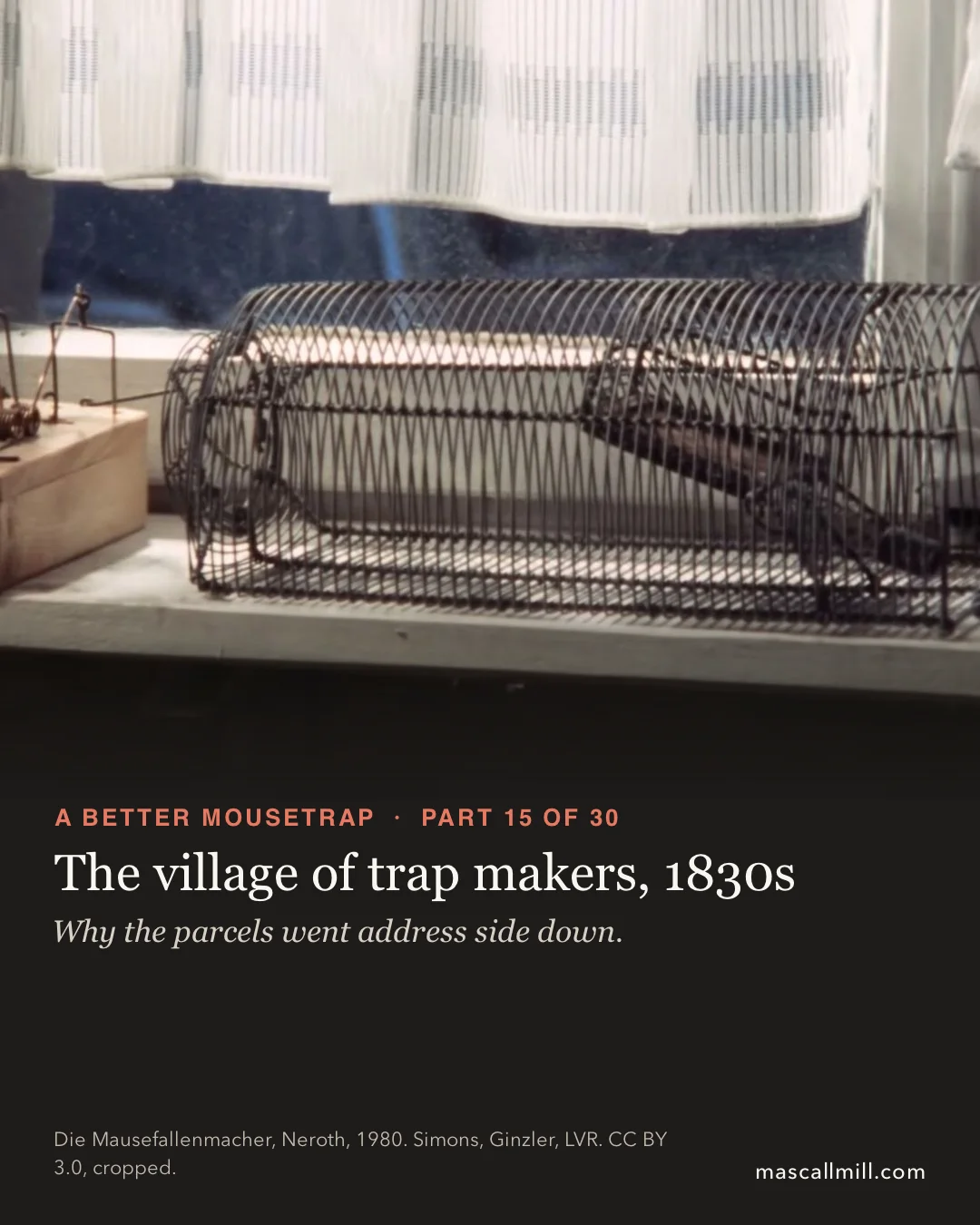
Part 14 was one trap from under one floor. Part 15 is a whole village that lived on them.
Address side down
Neroth is a village in Germany’s Eifel hills. Picture a woman at its post office, sending a parcel to her husband on the road. She puts it on the counter with the address face down.
A documentary filmed in the village in 1980 explains why. The parcel holds wire mousetraps, and a wire trap lasts. Once a pedlar had sold through a district, it was three years at least before he could work it again. So a route was worth hiding. The pedlars kept their next destination secret, and so did their wives.
They were the Mausfallskrämer, the mousetrap pedlars. They walked in pairs and talked in Jenisch, a secret language of travelling traders.
The teacher who wouldn’t teach
Neroth was poor. Its farms couldn’t feed it, and a fire in 1826 destroyed much of the village. Theodor Kläs, born there in 1802, trained as a teacher and then turned down a teaching post to go travelling for trade. The village’s own account lists Bavaria, Württemberg, Bohemia, Hungary, Savoy and Switzerland. The film and a 1992 local history name Slovakia. Somewhere along the way he learned wire work, and how to peddle it.
He came home in the 1830s, or by one local history around 1840, and taught his relatives, then the rest of the village with the help of its teacher, Michels. He later ran a shop in Paris for some years. By the 1840s, the film says, the trade had spread far enough that fewer people left Neroth for North America than left other villages.
There’s also a legend that a Neroth pedlar sold mousetraps to Columbus in 1492. The local yearbook that tells it says it’s probably a mistake.
At the wire
The whole household worked at the wire. The film gives thirteen hours a day or more for husband and wife where it was the main living, and about three for the children. Around 1900, about a hundred households in a village of 650 were doing it. One round trap took 22 rounds of wire, tied down in 176 places.
In, but not out
The round trap’s entrance is a wire funnel, wider outside than inside.
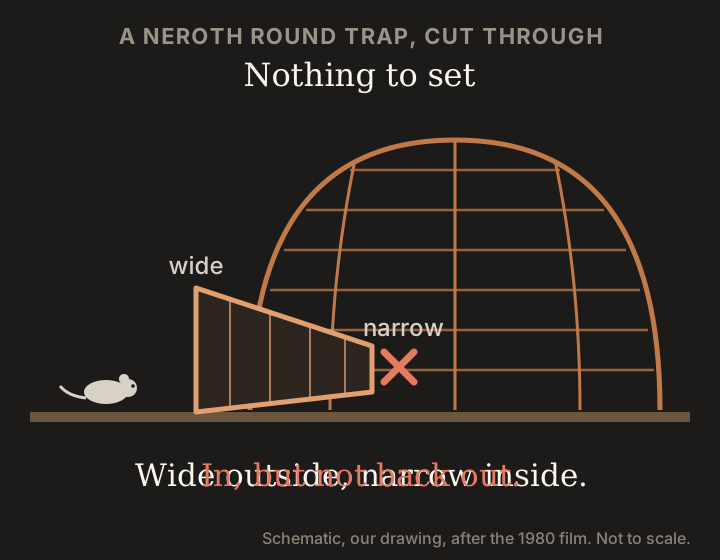
Many Neroth traps caught mice alive, the film says, and the mice were then drowned in the trap. A little tin door let you bait it and empty it.
The plate with a weight
The bigger one was called the Massenfänger, the mass catcher, up to 55 centimetres long. Inside its entrance is a tin plate fixed on one side. A mouse goes through it like a trapdoor, and a weight at the plate’s hinged end brings it straight back to where it started.
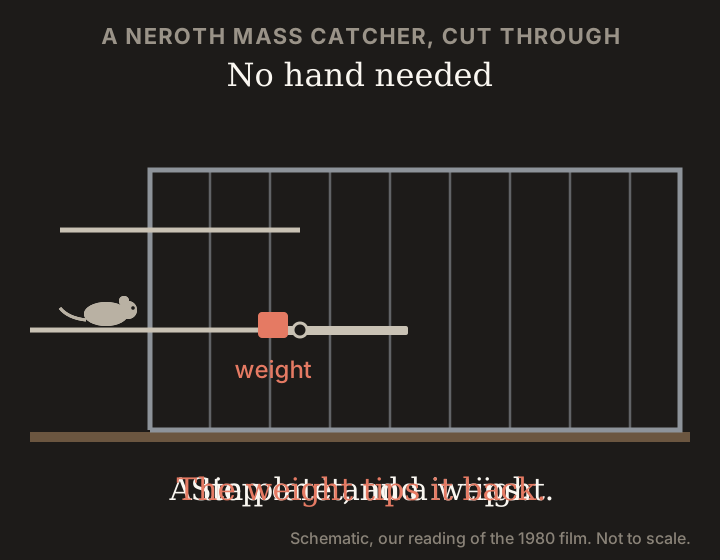
So here is a weight doing a person’s job. Part 11 would recognise that. The drawing is our reading of the film’s description.
Josef Pfeil’s workshop in the village made hole traps: a wooden block with a spring, a noose and a thread the mouse bites through. In the 1950s and 60s most went to Ireland and England, where the rules on poison were stricter, and Neroth called them Irish traps after where they went. Every one of those needed a new thread and a hand to set it.
1979
From the 1950s the home workers couldn’t compete with factory goods, and many left for building sites. Josef Pfeil’s workshop, the last one, closed in 1979. Since 1990 the mousetrap museum has had a classroom in the village school, built in 1844.
Next, part 16: The Perpetual, 1861.
A new part every day. Follow along on YouTube, Instagram, TikTok, Threads or Facebook, or come back to the series.
Sources
- Die Mausefallenmacher (Neroth/Eifel, 1980), 34 min, in German. Filmed by Gabriel Simons, edited and narrated by Hildegard Ginzler, LVR-Institut für Landeskunde und Regionalgeschichte, Alltagskulturen im Rheinland, CC BY 3.0: commons.wikimedia.org/wiki/File:Die_Mausefallenmacher.webm . The parcels, the three-year wait, the hours, the funnel, the plate and weight, Pfeil's hole traps (spring, noose and thread, and why Ireland and England wanted them) and the end of the trade come from its commentary, translated by us. The film says it recreates the work as faithfully as it can.
- Siegfried Stahnke, "Mausefallen aus Neroth", Heimatjahrbuch Kreis Daun 1985: heimatjahrbuch-vulkaneifel.de/VT/hjb1985/hjb1985.82.htm . The 1826 fire, Kläs turning down the teaching post and his shop in Paris, about 1840 for his models, 100 households of 650 people around 1900.
- Günther Kirchhof, "Mausefallen", Heimatjahrbuch Kreis Daun 1992: heimatjahrbuch-vulkaneifel.de/VT/hjb1992/hjb1992.86.htm . Kläs in the 1830s and his travels, Slovakia among them, the Columbus legend and why it's probably an error, Josef Pfeil's firm stopping in 1979, the museum in a classroom of the school built in 1844, opened 21 October 1990.
- Gemeinde Neroth, Mausefallenmuseum: neroth.de/mausefallenmuseum/ . Kläs born 1802, his travels, the schoolchildren's share of the work.
- Kulturland Rheinland-Pfalz, Mausefallenmuseum Neroth: kulturland.rlp.de/datenbanken/einrichtungen/einrichtung/mausefallenmuseum-neroth . The Mausfallskrämer walking in pairs and speaking Jenisch, selling across the German-speaking lands.
- Joachim Dagg, Weltmurksbude, 5 April 2012: historiesofecology.blogspot.com/2012/04/no-more-mouse-traps-drummond-142012.html . The name Irish for traps made in Germany and shipped to Britain.