 Mascall Mill
Under the floor, 1700s
Act III: Four hundred years of resetting ·
Listen · 3 min
That's the latest part. Part 20 comes next, with a new part every day: follow along on YouTube, Instagram, TikTok, Threads or Facebook.
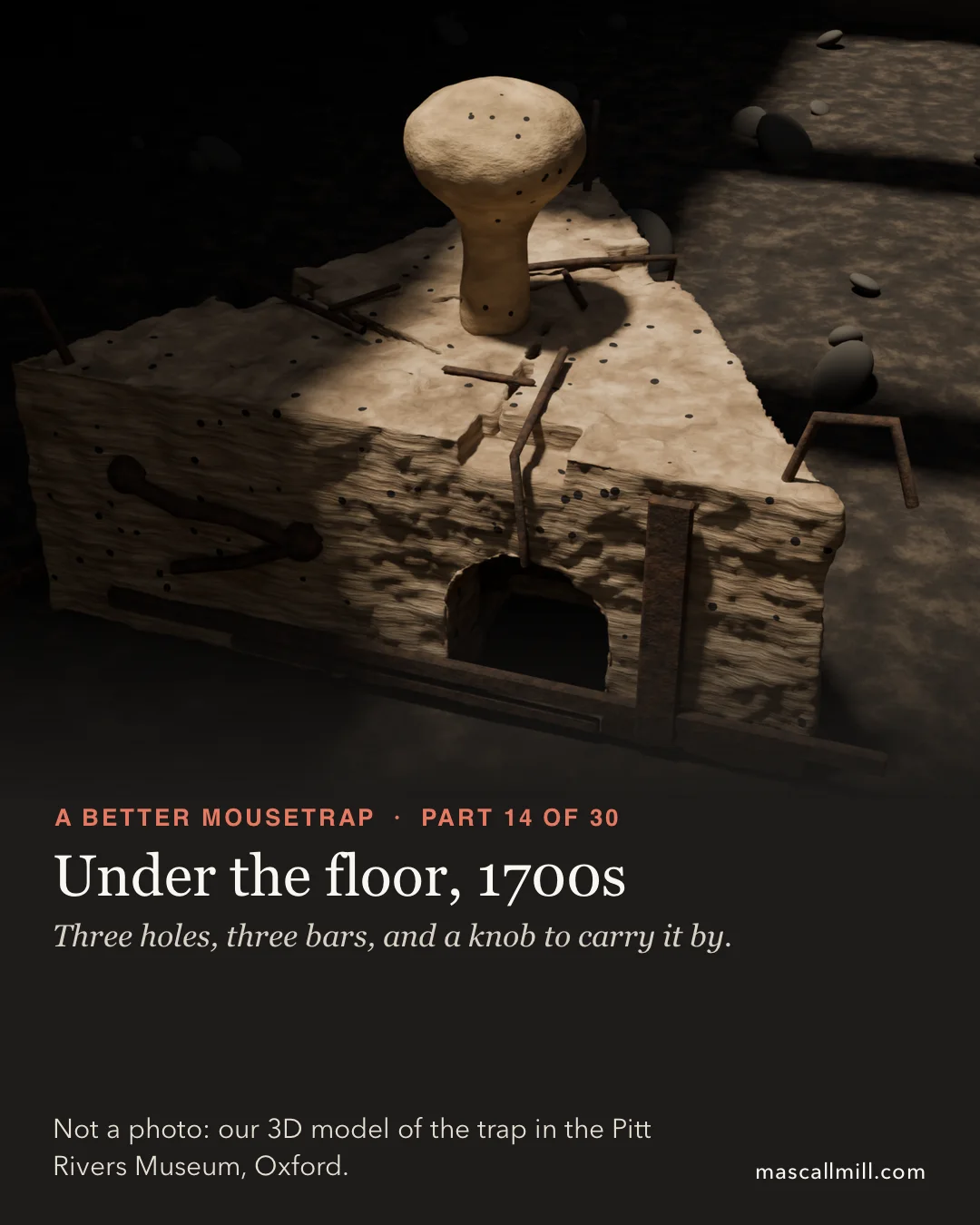
Part 13 ended on a boy’s hand on a lever: one trap, one mouse, and someone sets it again. Part 14 is somebody’s answer to that. It has three of everything.
Under the oak floor
In 1911 a house in Market Square, Wantage, was being pulled down. Wantage was in Berkshire then. It’s in Oxfordshire now. Under the house’s oak floor lay a block of wood and rusted iron, along with a bundle of brimstone matches.
The Pitt Rivers Museum in Oxford has the trap now. F. Williams of Wantage, presumably the house’s last owner, handed it over in February 1911, and the museum paid seven shillings and sixpence for it. That’s roughly twenty pounds in today’s money, says the essay on the museum’s site.
The matches are the best clue to its age. Luke Houston, who wrote that essay, calls them circumstantial evidence, and from them puts the trap no later than the mid 1800s and probably no earlier than the 1700s. So the “1700s” in our title is the early end of a careful guess.
Three of everything
The base is one triangular block, roughly hewn, carved and hollowed. Each of its three sides carries the same thing: a neatly bored hole, and springs that drive a blunt iron bar. The metal is most likely iron, possibly a local smith’s work, while the small cross-bars and nails look factory-made.
On top sits a wooden handle, probably taken from a piece of furniture. The essay says what it was for: “enabling the trap setter to lift and position the trap” without disturbing the set mechanism. Once this thing was set, you didn’t want to bump it.
Three snaps, then a person
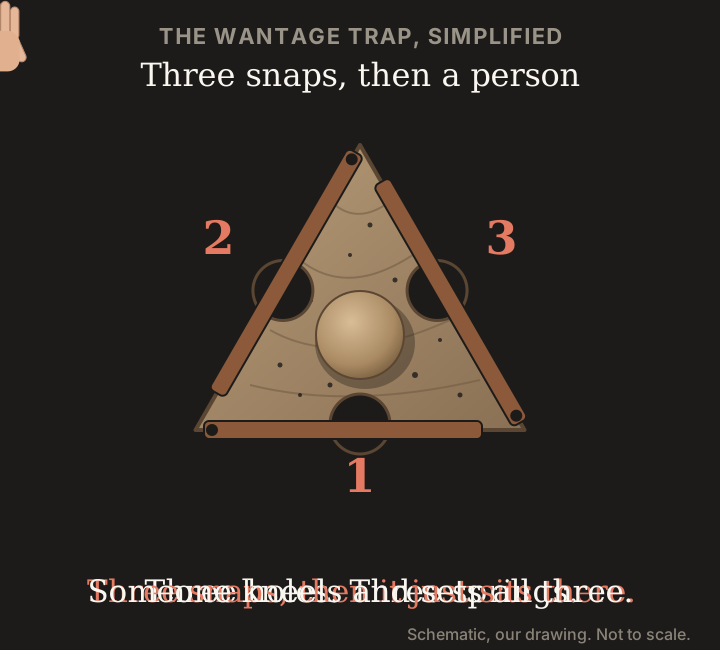
That’s the whole improvement. One snap becomes three, and it sits there until someone gets down on the floor and sets it again. The essay doesn’t say how it was set, so this part is our reading: a spring, once it’s gone, stays gone until a hand presses it back.
Mascall’s mill, in part 11, was probably more than a century older, and it had nothing to set. This trap took more iron and more kneeling.
Who was left
Why was it still under the floor? The essay offers three guesses: it didn’t work; the owner died or moved away and left it; or, the one it calls most likely, the household got a cat and forgot it. Nobody knows.
The essay also notes that another household pest “was certainly resident and very much alive” when the trap came up: a wood-eating beetle larva, in that worm-eaten wood. The house was coming down, and the beetle was fine.
The essay sees the trap as a possible ancestor of the single-spring snap trap, which arrives in part 19. It also says that “by far the most effective mousetrap is still the domestic cat”. Part 3 would agree. That one never needed setting, only feeding.
Next, part 15: The village of trap makers, 1830s.
A new part every day. Follow along on YouTube, Instagram, TikTok, Threads or Facebook, or come back to the series.
Sources
- Luke Houston (Wolfson College), "An Early Triple Sprung Mousetrap", England: The Other Within, Pitt Rivers Museum, with the museum's photograph of the real trap: england.prm.ox.ac.uk/englishness-Mousetrap.html . The find, the house, F. Williams, the accession and payment, the matches and the dating, the construction, the handle, the beetle larva, the guesses about why it was left, and the snap-trap and cat lines all come from this essay.
- Pitt Rivers Museum, Oxford, 1911.63.1: "Triple-sprung mouse-trap from Market Square, Wantage, Oxfordshire; donated by F. Williams"; "A triple mousetrap from Wantage found under the floorboards of a demolished house": england.prm.ox.ac.uk/englishness-Object-biographies-details.html .