 Mascall Mill
The Dutch paint one, 1660
Act III: Four hundred years of resetting ·
Listen · 2 min
That's the latest part. Part 20 comes next, with a new part every day: follow along on YouTube, Instagram, TikTok, Threads or Facebook.
Part 12 was a mousetrap with no door at all: a play. Part 13 is the opposite, a real one, on a table, painted.
A small picture
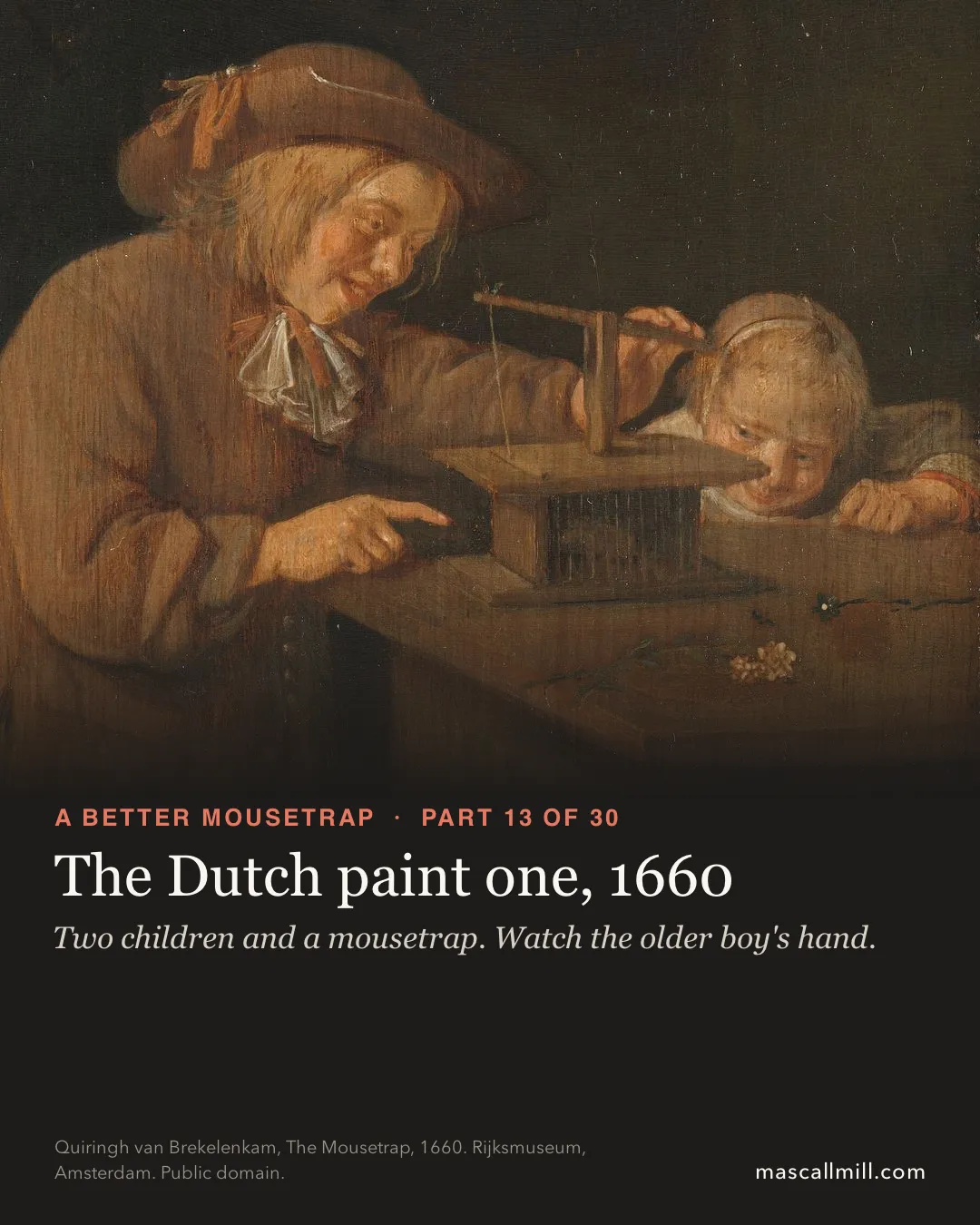
In 1660 Quiringh van Brekelenkam signed a panel “Q.B. 1660.” He worked in Leiden, painting tailors’ and cobblers’ shops and ordinary rooms. This one is 18.5 by 16.5 centimetres, smaller than a sheet of printer paper. The Rijksmuseum in Amsterdam has it, and its description is one sentence: two children with a mousetrap in which a mouse has been caught.
The older boy, in a broad brown hat, grins and points at the trap. A younger child rests their chin on the table edge, peering in. The trap is a wooden box with barred sides. On top, a post holds a lever, and a thread runs from the lever down to the box.
Everyone painted one
He wasn’t alone. Boys with mousetraps “enjoyed great popularity among Dutch painters” of the late 1600s and early 1700s, as one catalogue puts it. Gerrit Dou, also in Leiden, painted one in the late 1640s. Dominicus van Tol painted a boy holding up a trap by candlelight. Adriaen van der Werff painted another about twenty years later.
A Dutch buyer in 1660 could also read a trapped mouse in the emblem books of the day. In 1627 Jacob Cats printed a mouse in a trap, going for the bacon, under the motto Fit spolians spolium: who takes the plunder becomes the plunder. His book even gave the English:
Like as the silly mouse, the bayte of bacon to obtaine, And catchinge it is caught her selffe
Cats meant a lover stealing a kiss. Whether Brekelenkam meant anything at all is another matter: one catalogue says his scenes “refrain from explicit symbolism”. It may just be two children and a mouse.
The hand on the lever
The scholars who edited Cats’s book online call his a well-known, popular trap that catches the animal alive. The mouse goes in for the bait, and the trap shuts on it.
Then look at the older boy’s other hand. It’s on the lever. Nothing in that box opens, empties or sets itself. A person does it, every time.
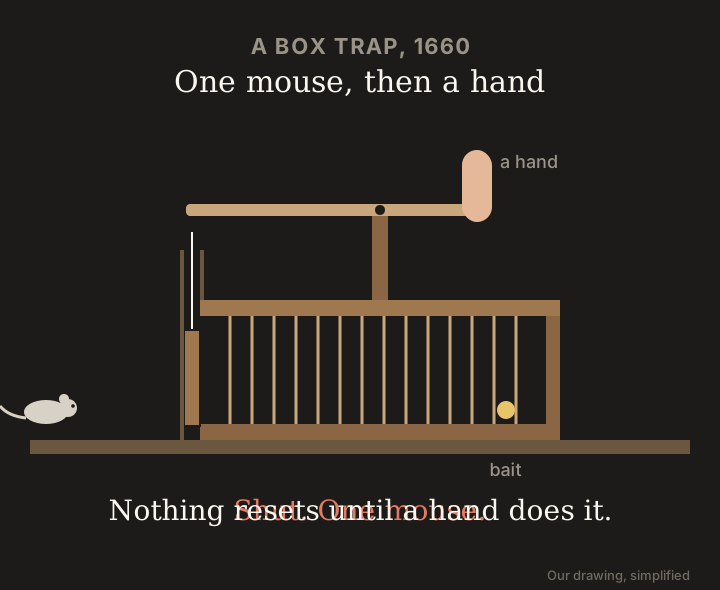
That’s the problem this whole series keeps coming back to. Seventy years earlier, in part 11, Mascall’s mill turned a quarter of the way round after each mouse, and the next baited vane was already in place. Nothing had to be set again. The painted trap waits for a child.
Next, part 14: Under the floor, 1700s.
A new part every day. Follow along on YouTube, Instagram, TikTok, Threads or Facebook, or come back to the series.
Sources
- Quiringh Gerritsz. van Brekelenkam, The Mousetrap (De muizenval), 1660, oil on panel, 18.5 × 16.5 cm, signed "Q.B. 1660.", Rijksmuseum SK-A-62, public domain: rijksmuseum.nl/en/collection/SK-A-62 . Museum description: "Twee kinderen met een muizenval waarin een muis gevangen is." Image: Wikimedia Commons, File:De muizenval, SK-A-62.jpg.
- Piet Bakker, "Quiringh van Brekelenkam", The Leiden Collection Catalogue (2017): born 1622, Leiden Guild of Saint Luke from February 1648, "thought to have died shortly after 1668", painter of "the shops of tailors and cobblers": theleidencollection.com/artists/quiringh-van-brekelenkam/ .
- RKD Studies, Dulwich Picture Gallery catalogue, Quiringh van Brekelenkam: "households, workshops and peasant interiors"; his scenes "refrain from explicit symbolism": dulwich-picture-gallery-i.rkdstudies.nl/brakenburgh-calraet/quiringh-van-brekelenkam/ .
- Junko Aono, Dominicus van Tol, A Boy with a Mousetrap by Candlelight, The Leiden Collection (2017): "Depictions of a boy with a mousetrap enjoyed great popularity among Dutch painters", with Brekelenkam's SK-A-62 in note 10: theleidencollection.com/artwork/a-boy-with-a-mousetrap-by-candlelight .
- Jacob Cats, Sinne- en minnebeelden (Middelburg, 1627), emblem 12, "Fit spolians spolium", with the book's own English verse, Emblem Project Utrecht: emblems.hum.uu.nl/c162712.html . Its note on the trap: "een bekende en populaire val, waarin het dier levend wordt gevangen".
- Gerrit Dou, The Mousetrap, 1645–50, Musée Fabre, Montpellier: utpictura18.univ-amu.fr/en/notice/22966-the-mousetrap-gerrit-dou .
- Adriaen van der Werff, A Boy with a Mousetrap, about 1678–9, National Gallery, London, NG3049: nationalgallery.org.uk/paintings/NG3049 .