 Mascall Mill
The Mousetrap, c.1600
Act III: Four hundred years of resetting ·
Listen · 3 min
That's the latest part. Part 20 comes next, with a new part every day: follow along on YouTube, Instagram, TikTok, Threads or Facebook.
Part 11 was a mill from a book of 1590 that waits for the mouse to come to it. About ten years later, a prince on a London stage set a trap for a king, and called it a mousetrap.
The bait
Hamlet thinks his uncle, the new king, murdered his father. All he has is a ghost’s word. Then a company of players comes to court, and he remembers something he has heard:
I haue heard that guilty creatures sitting at a play, Hath, by the very cunning of the scene, confest a murder Committed long before.
So he asks them for “the murder of Gonsago”, with “some dozen or sixteene lines” of his own put in. Then comes the line people still quote:
The play’s the thing, Wherein I’le catch the conscience of the King.
Every old spelling here comes from the first printed edition, in 1603.
The name
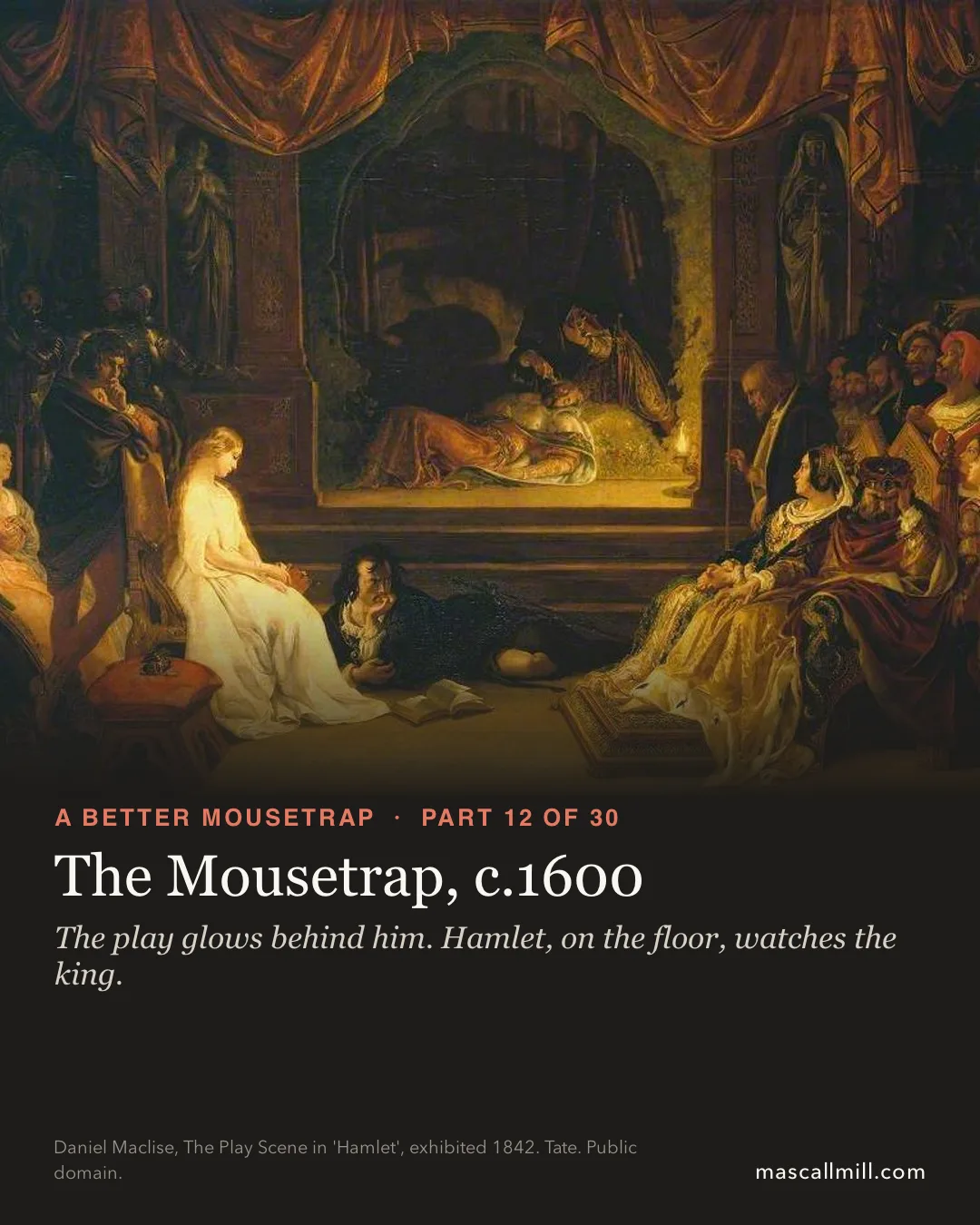
Hamlet tells his friend Horatio to watch the king, and says he will do the same: “For I mine eies will riuet to his face.” In Daniel Maclise’s painting of the scene, from 1842, the little stage glows in the middle of the room. Hamlet is on the floor with his back to it, his face turned toward the king.
The king asks what the play is called. Hamlet answers:
Mouse-trap: mary how trapically
“Mary” is an old oath, roughly “indeed”. The next printing, in 1604, has “Tropically”. That means figuratively, by a figure of speech, and it may also be a pun on “trap”. The 1603 printing spells the pun out.
It goes off
Nobody touches the king, and nobody accuses him. On the little stage, the poisoner pours his vial into a sleeping man’s ears. Hamlet says, “He poysons him for his estate.” And the king gets up:
Lights, I will to bed.
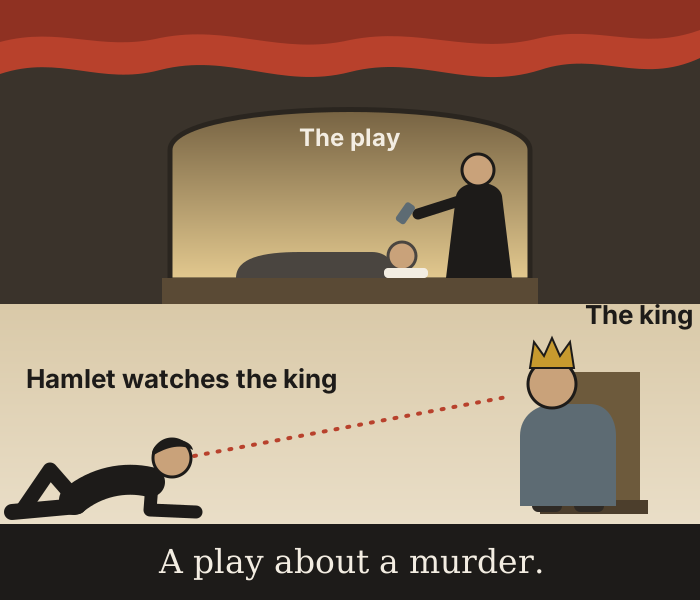
Part 6 had Augustine’s version: the animal comes for the food, and taking it is what catches it. Hamlet’s trap has no spring and no door. The bait is a story, and the only thing that moves is the guilty man.
We found nothing that connects Shakespeare to Mascall’s mill, and he didn’t need it. He needed a word his audience already understood.
Still running
In 1952, a murder mystery by Agatha Christie opened in London. Its stage title had to change, because another producer objected to the old one. Her son-in-law, Anthony Hicks, suggested a new title out of Hamlet: The Mousetrap. It’s still running, past 30,000 performances.
Next, part 13: The Dutch paint one, 1660.
A new part every day. Follow along on YouTube, Instagram, TikTok, Threads or Facebook, or come back to the series.
Sources
- William Shakespeare, The Tragicall Historie of Hamlet (first quarto, London, 1603), every old-spelling quotation here, Internet Shakespeare Editions: internetshakespeare.uvic.ca/doc/Ham_Q1/ .
- William Shakespeare, Hamlet (second quarto, 1604), 3.2, "Tropically", Internet Shakespeare Editions: internetshakespeare.uvic.ca/doc/Ham_Q2/ .
- Note to Hamlet 3.2.237, Shakespeare Navigators: "Figuratively. A trope is a figure of speech" and "Hamlet may also be punning on 'trap.'": shakespeare-navigators.ewu.edu/hamlet/Hamlet_Note_3_2_237.html .
- Royal Shakespeare Company, Hamlet, dates and sources, on the likely date of writing (1601): rsc.org.uk/hamlet/about-the-play/dates-and-sources .
- Agatha Christie Limited, The Mousetrap (Emile Littler, Anthony Hicks, the Hamlet title): agathachristie.com/en/stories/the-mousetrap . Run and performance count: "The Mousetrap," Wikipedia: en.wikipedia.org/wiki/The_Mousetrap .
- Daniel Maclise, The Play Scene in 'Hamlet', exhibited 1842, Tate N00422: tate.org.uk/art/artworks/maclise-the-play-scene-in-hamlet-n00422 . Image: Wikimedia Commons, public domain.