 Mascall Mill
A mill to take mice, 1590
Act II: The mill ·
Listen · 2 min
That's the latest part. Part 20 comes next, with a new part every day: follow along on YouTube, Instagram, TikTok, Threads or Facebook.
Part 10 ended with twelve mousetraps in a book printed the year after its author died, and one of them that didn’t need anyone. Here it is.
The chapter
It takes up less than a page. The heading is “A Mill to take Mice”, and it begins:
This engine or Mill, is made of ij. thin bords, and thicker in the midst, then at the ends.
Two thin boards, slotted into each other to make a cross: four vanes. A hole is bored through the middle, and through it goes “a great wyar, or a smal pinne of wood”. The pin is set into a thick board on a table, half a yard off the ground, so the vanes hang out over the edge. Under the mill goes a pan or pot of water.
Then the bait:
baite your mill on both sides of each leafe with some butter, mixt with otmele and sugar
And a little more oatmeal on the board, an inch from the mill, “to tice them to the mill”.
How it works
A mouse comes for the oatmeal on the board, reaches for the butter and sugar on the nearest vane, and steps out onto it. The vane turns under the mouse, and the mouse goes into the water.
The mill has turned a quarter of the way round. The next vane is now where the last one was, still baited on both sides. Nothing has to be set again. It just waits.
Mascall says he had seen it take “threescore or more perhaps in a night”, sixty mice, “if there be store”.
The line to remember
One sentence in the chapter matters more than the rest:
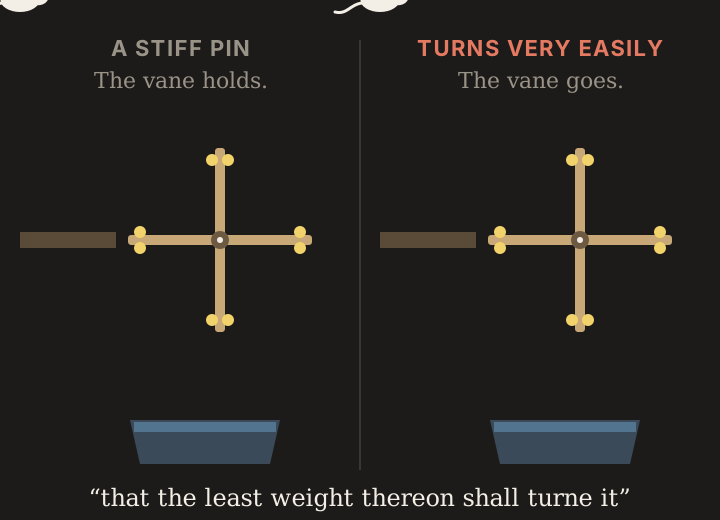
Ye shall make your mill to turne very easely, that the least weight thereon shall turne it.
If the pin is stiff, a mouse can stand on the vane, eat, and walk back to the board. The trap only works if the lightest mouse in the house can turn it.
David Drummond, the researcher from part 10, built one from this chapter, and it’s now in the Museum of English Rural Life in Reading. Remember the line about turning easily. It’s the hard part, and it will come back.
Next, part 12: The Mousetrap, c.1600.
A new part every day. Follow along on YouTube, Instagram, TikTok, Threads or Facebook, or come back to the series.
Sources
- Leonard Mascall, A Booke of Fishing with Hooke & Line … Another of sundrie Engines and Trappes to take Polcats, Buzards, Rattes, Mice and all other kindes of Vermine & Beasts whatsoever (London: John Wolfe, 1590), the chapter "A Mill to take Mice". Early English Books Online text, Text Creation Partnership A07166 (CC0): github.com/textcreationpartnership/A07166 . Quoted with the long s written as s, and accents and the drop capital dropped.
- Museum of English Rural Life, object 2008/1, "Mill to take mice", a replica, maker David Drummond, David Drummond Collection of Mouse Traps: reading.ac.uk/adlib/Details/collect/7290 .