 Mascall Mill
The Perpetual, 1861
Act III: Four hundred years of resetting ·
Listen · 3 min
That's the latest part. Part 20 comes next, with a new part every day: follow along on YouTube, Instagram, TikTok, Threads or Facebook.
In part 15, Josef Pfeil’s hole traps each needed a new thread and a hand to set them. Part 16 is a trap built so that no hand was needed at all.
The Inventive Factory
Colin Pullinger was born in 1814 in Selsey, near Bognor, in Sussex. He called his workshop there the Inventive Factory, and a blue plaque in Selsey marks him.
In 1859 he registered a mousetrap with the Designs Office and called it the Automaton. In 1861 he registered another, number 4373, and called it the Perpetual. The Museum of English Rural Life in Reading, which has one, calls it “simpler and more elegant” than the first.
A see-saw in the middle
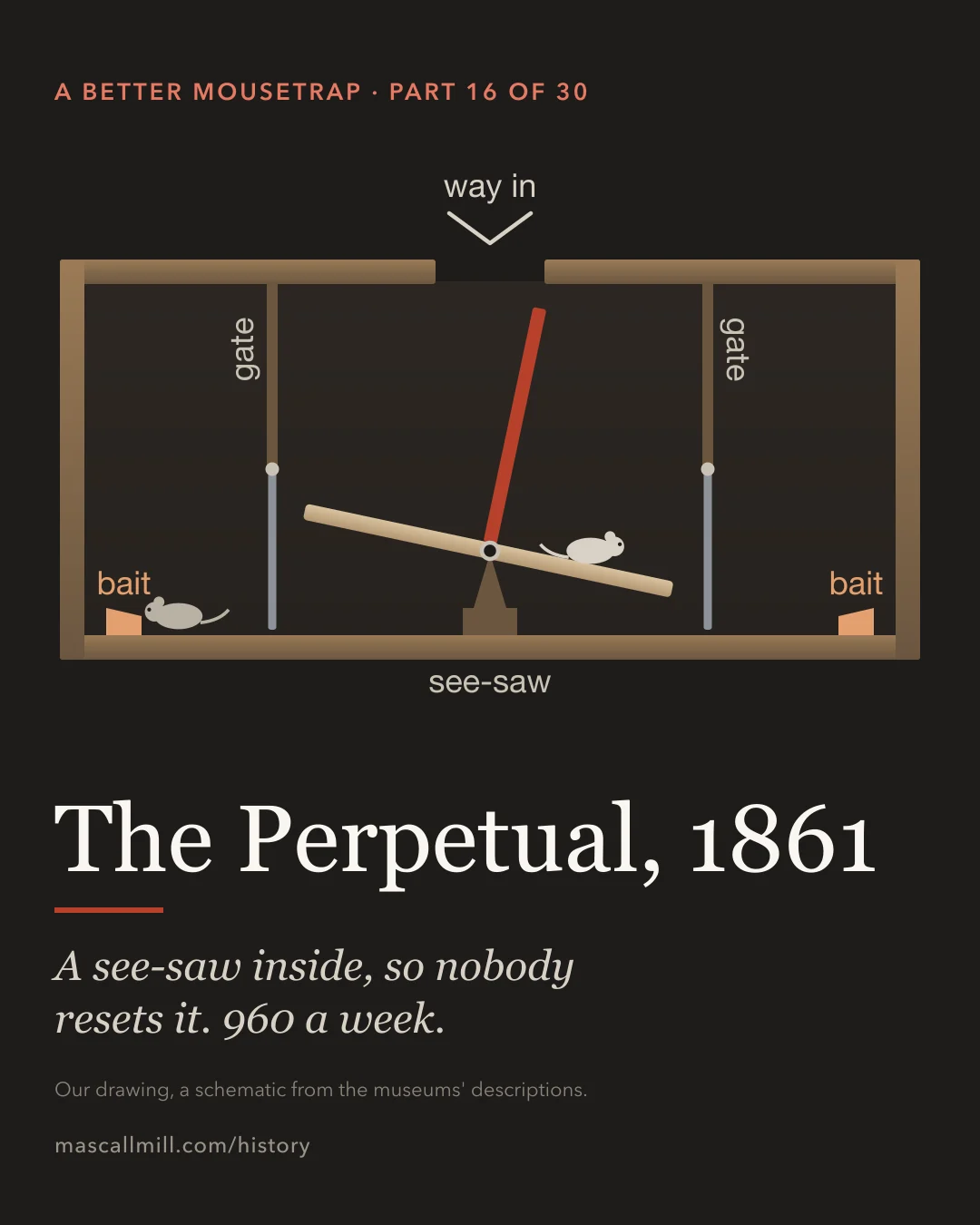
The Perpetual is a long wooden box with a way in on top. Inside, a see-saw runs along the middle with a wall standing up from its centre, and there’s a chamber at each end with bait in it.
A mouse climbs in on whichever side of the see-saw is up. Its weight tips that side down, and the wall in the middle swings across and shuts the way back. Ahead is a one-way gate into the chamber at the end. And the other side of the see-saw is now up, open for the next mouse.
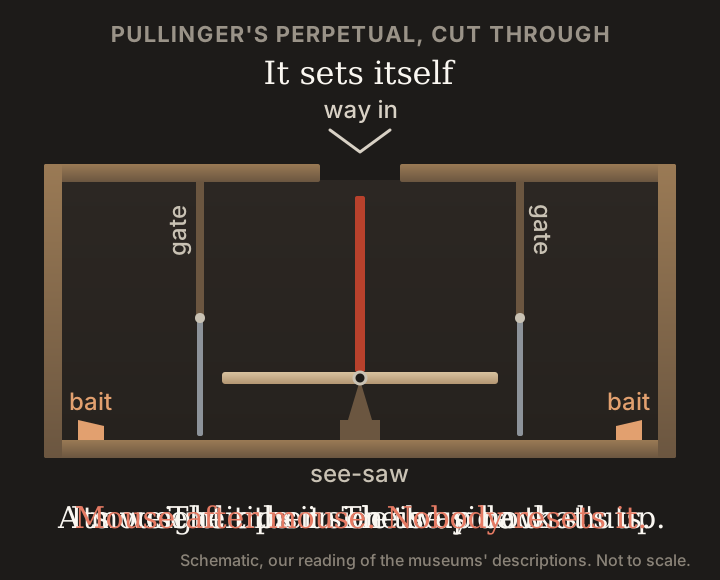
So nobody has to set it again. The museum’s record says it allows “the capture of multiple mice without the need to be reset”. His label promised it “will last a lifetime”.
That was 271 years after Leonard Mascall’s book. Part 11’s mill came round by turning. Pullinger’s see-saw does the same job by rocking one way, then the other.
960 a week
The traps sold. In the 1880s, the museum’s blog says, his staff of “around 40 men and boys churned out 960 traps a week”. By 1885 the firm had reportedly made two million, says one of the museum’s records. Colin Pullinger and Sons kept making them until 1920.
Still working in 2016
The museum’s Perpetual came from the collection of David Drummond, who collected British mousetraps and wrote a book about them. In February 2016 the staff found a mouse inside it, in a glass case. Nobody had put bait in it. The museum’s conservator thinks the mouse was building a nest, nibbled a label tied on with string, and chased the string when it fell inside.
A trap like this keeps a mouse alive only if someone checks it, and nobody checks a museum case. The mouse died there. The museum kept it, in the trap: a design from 1861, still working 155 years on.
The Perpetual put a see-saw where a hand had been. The same year, on the other side of the Atlantic, two men in Pennsylvania tried a key.
Next, part 17: Wind it up, 1861.
A new part every day. Follow along on YouTube, Instagram, TikTok, Threads or Facebook, or come back to the series.
Sources
- Museum of English Rural Life, University of Reading, object 2008/15, Trap, mouse, the 'Perpetual', Colin Pullinger and Sons, made 1876–1929: reading.ac.uk/adlib/details/collect/16893 . The registration of 1861 (No. 4373), the Automaton of 1859 (No. 4158) and "simpler and more elegant", the see-saw, David Drummond's collection, and the mouse found in it in February 2016.
- Museum of English Rural Life, object 52/266, Trap, mouse, "similar in design to Pullinger's 'perpetual' mouse trap": reading.ac.uk/adlib/Details/collect/1555 . Pullinger born 1814 in Selsey near Bognor, the two baited compartments, the see-saw, the one-way gate, catching mice "without the need to be reset", about two million traps by 1885, production until 1920.
- Museum of English Rural Life blog, "155-year old mouse trap claims its latest victim", 3 February 2016: blogs.reading.ac.uk/merl/2016/02/03/155-year-old-mouse-trap-claims-its-latest-victim . Nobody had baited the trap, "will last a lifetime".
- Museum of English Rural Life blog, "How a mouse died in our Victorian mouse trap", 8 February 2016: blogs.reading.ac.uk/merl/2016/02/08/how-a-mouse-died-in-our-victorian-mouse-trap . The Inventive Factory, "around 40 men and boys" making "960 traps a week" in the 1880s, the blue plaque in Selsey, the string from the label.
- The Novium Museum, Chichester, "Pullinger Mousetrap" (thenovium.org.uk, article 33858), read through search results in November 2026; the site no longer loads. The way in from above, the beam with a partition in the middle, the see-saw tipping toward the mouse and shutting it in, the one-way gate, and the see-saw rocked over for the next mouse.