 Mascall Mill
Wind it up, 1861
Act III: Four hundred years of resetting ·
Listen · 3 min
That's the latest part. Part 20 comes next, with a new part every day: follow along on YouTube, Instagram, TikTok, Threads or Facebook.
Part 16 was Colin Pullinger’s see-saw, registered in Sussex in 1861. That same year, two men in northern Pennsylvania patented a trap you wound with a key.
A key, a spring, a wheel
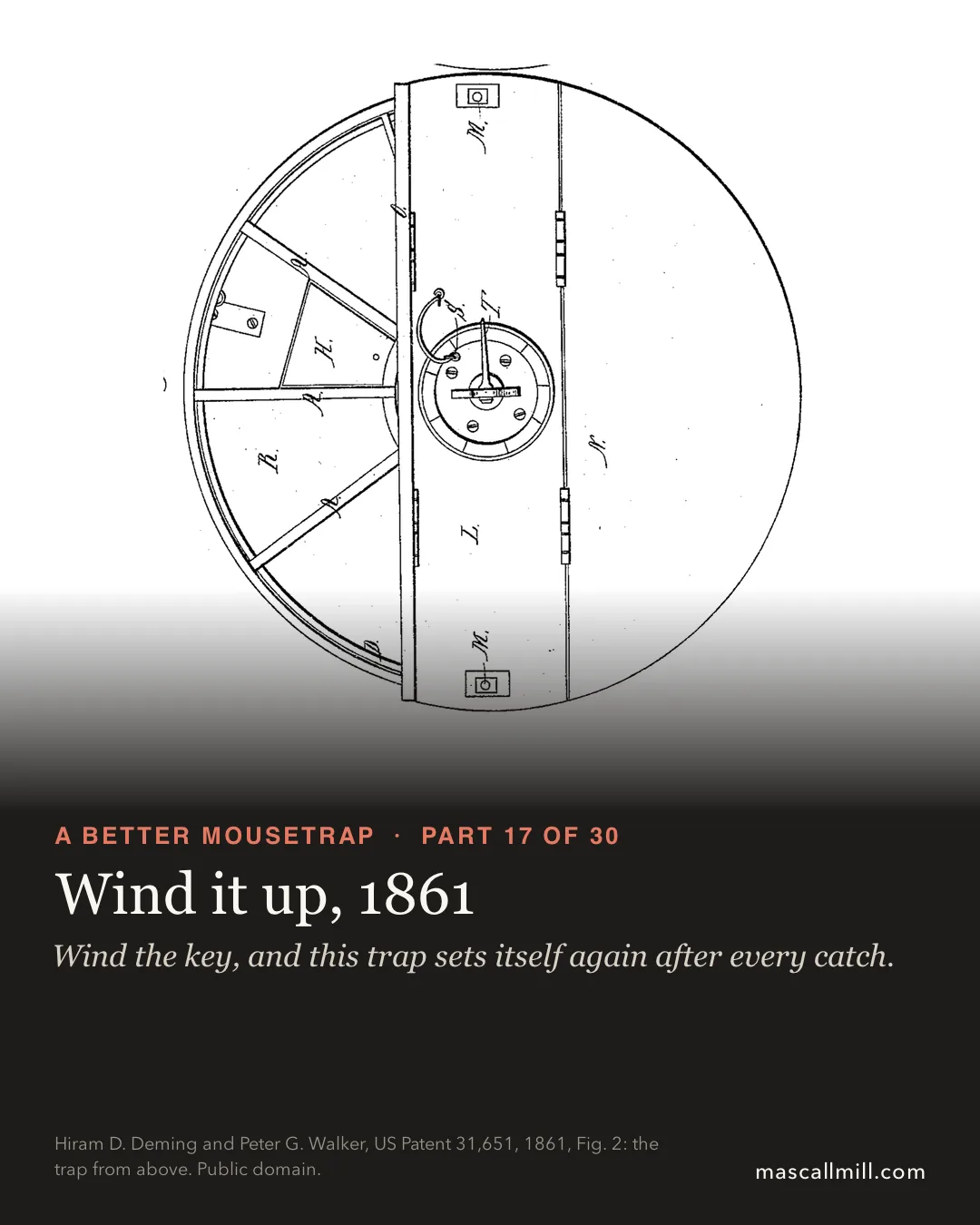
US patent 31,651 is dated 5 March 1861. It names Hiram D. Deming and Peter G. Walker, of Delmar, in Tioga County, Pennsylvania, and calls itself an improvement “in Traps for the Destruction of Rats, Mice, Squirrels, &c.” The drawing is headed Cage Trap.
From the outside it’s a round box: a wooden disc for the floor, a wall of bent sheet metal, and a lid in hinged pieces. One piece has a glass window, “in order that the animal may better see the bait, and also may have less fear in entering the trap.” It also let you look in without opening it.
Inside, partitions run out from a central shaft like the spokes of a wheel, dividing the box into “any desired number of compartments.” Each compartment has a bait hook near the middle. Under the floor, a flat coiled spring sits on the same shaft. Turn the key and you turn the shaft, wind the spring, and turn the whole wheel with it.
It sets itself
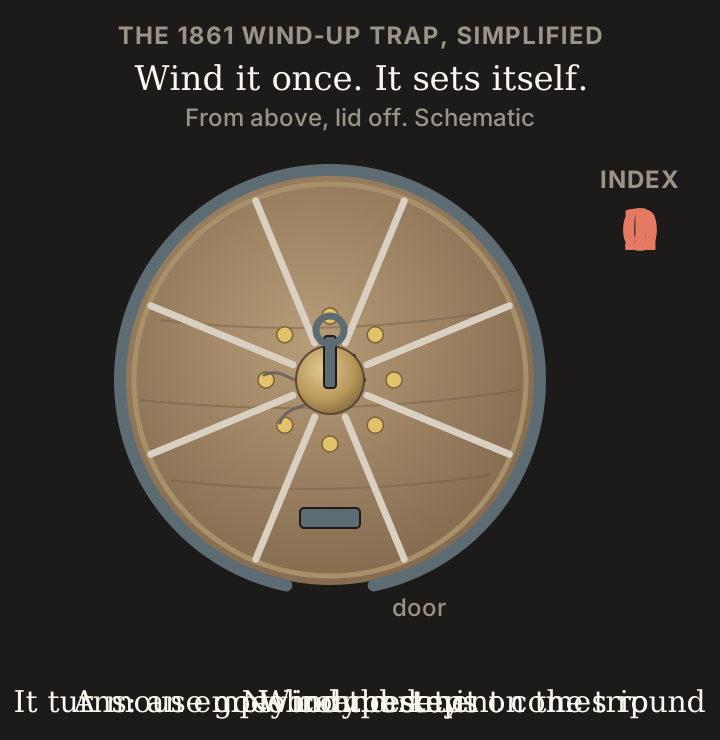
The outer ends of the partitions are joined by a notched ring, and a lever catches in a notch to hold the wound spring. A rat or a mouse comes in the door and steps on a trip. The trip moves the lever, the notch lets go, and the spring turns the wheel, “pushing the animal away from the door and thus entrapping him at the same time that the trap is set for another animal.” The next compartment is now at the door, empty and baited.
Nobody kneels down to set it. That’s the whole point of the patent.
Two ways to use it
The patent gives two. Leave the compartments closed, and it goes on catching “until each compartment has a prisoner.” Or take out a loose piece in the floor by the door, set the trap over a pail of water, and the wheel pushes each animal into the pail. That way, the patent says, one winding was good for a hundred rats.
Either way, what the patent calls the index keeps count. Walking up to the trap, you could see “how many times the trap has sprung.”
Not the first, and they said so
The patent is plain about what it isn’t claiming: “the use of a coiled spring, of rotary radial partitions, or a window as such, when employed in traps.” What Deming and Walker claimed was their arrangement of those parts, with the sheet-metal box, the index and the trip.
They weren’t the first in their own state, either. In 1858 Samuel Gibson of Martic Township, in Lancaster County, Pennsylvania, patented what he called the “Self-Resetting Rat or Mouse Trap.” In his, the animals’ own weight tipped a floor that set the trap again.
Gibson in 1858, then Pullinger in Sussex and Deming and Walker in Pennsylvania in 1861: in three years, the trap that sets itself was invented at least three times. We found no record of what became of Deming and Walker’s. Mascall’s mill, in part 11, had done the same job 271 years earlier, with no key and no spring.
Next, part 18: Emerson never wrote it.
A new part every day. Follow along on YouTube, Instagram, TikTok, Threads or Facebook, or come back to the series.
Sources
- Hiram D. Deming and Peter G. Walker, of Delmar, Tioga County, Pennsylvania, "Animal-Trap", US Patent 31,651, dated 5 March 1861, text and drawings: patents.google.com/patent/US31651A/en . The box, the window and why it's there, the partitions, bait hooks, spring, key, notched ring, lever and trip, the two ways to use it, the hundred rats, the index, and what the patent doesn't claim all come from it.
- Samuel Gibson, of Martic Township, Lancaster County, Pennsylvania, "Trap for Animals", US Patent 20,873, dated 13 July 1858, called by its inventor the Self-Resetting Rat or Mouse Trap: patents.google.com/patent/US20873A/en .