 Mascall Mill
The strangest ones
Act III: Four hundred years of resetting ·
Listen · 3 min
That's the latest part. Part 27 comes next, with a new part every day: follow along on YouTube, Instagram, TikTok, Threads or Facebook.
Part 22 counted more than 4,400 mousetrap patents. The Patent Office asked only that a trap do “more or less what the inventor claims it will do”. Here are three that did something nobody else claimed.
1882: the revolver
In August 1882, James A. Williams of Fredonia, Texas, applied for a patent on a trap built around a gun. A revolver sits on a small frame. A treadle holds down a spring-loaded lever, and a rod runs from the lever to the trigger.
You push the treadle into the mouth of a burrow. Its stated aim is a means by which “animals which burrow in the ground can be destroyed”. The animal steps out onto the treadle, the lever springs up, and the rod “causes the fire-arm to go off.”
The patent adds that the trap “will give an alarm each time that it goes off, so that it can be reset”. It doesn’t say how. With a revolver, it may not have needed to.
1903: the little car
In November 1902, Allen W. Phillips of Providence, Rhode Island, applied for a patent on a trap that catches the mouse alive and then lets it drive.
It’s a wire cage with a spring door and a bait hook. Pull the bait and the door shuts. At one end is a big hollow wheel, open to the cage. A trapped mouse looks for a way out, climbs into the wheel, and “as soon as the animal lands on its circular wall” the wheel turns, and the whole trap rolls across the floor.
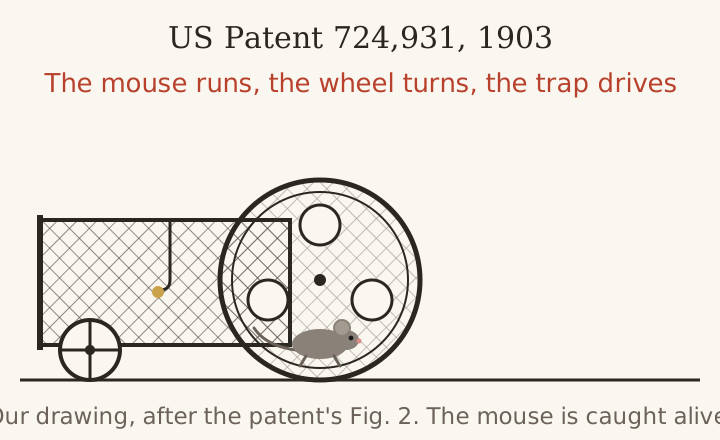
The patent suggests shaping it “to represent a steam-roller, automobile, or other miniature vehicle”. It was assigned to a firm with the best name in this series: the Animal Automobile and Novelty Company.
1908: the bell
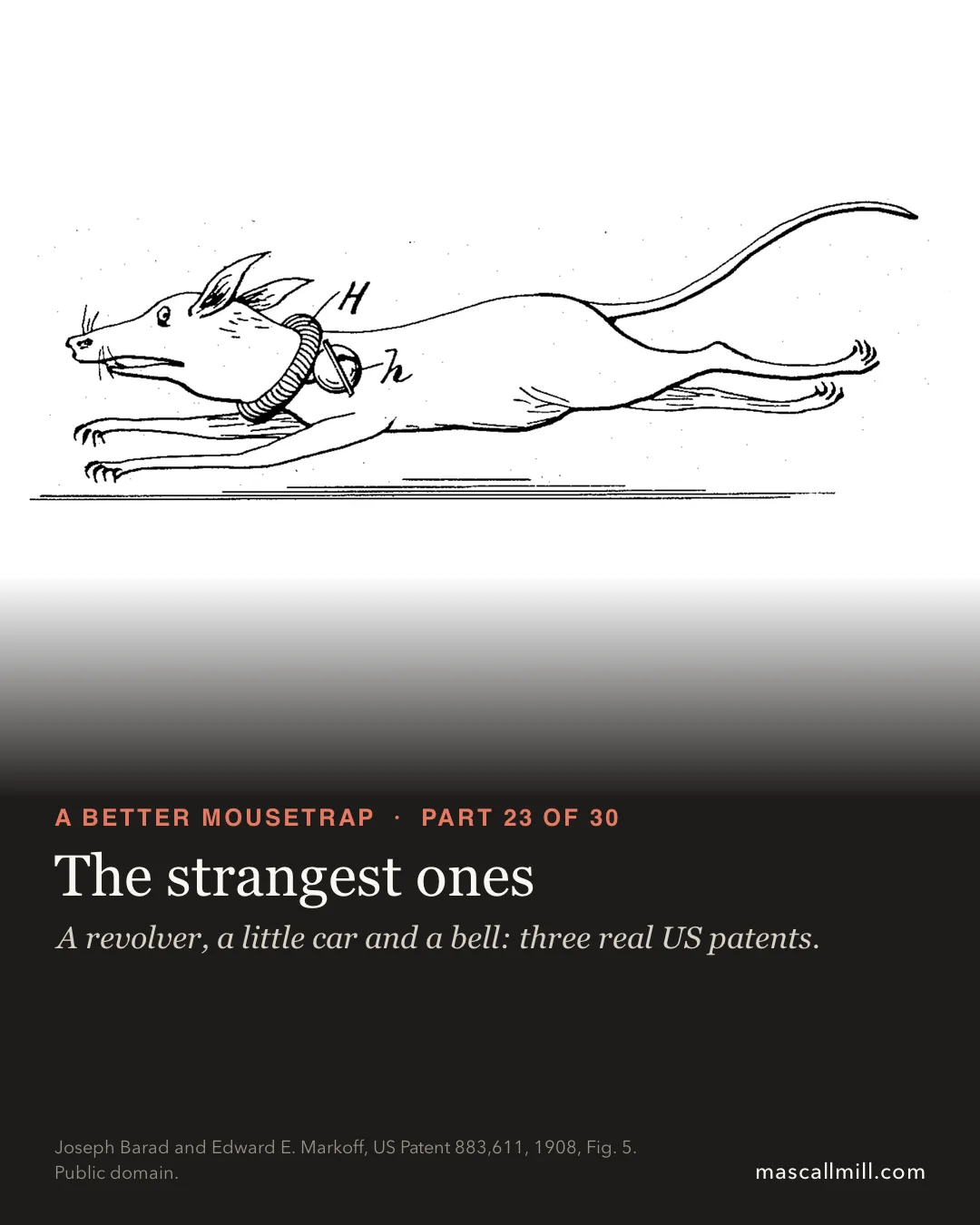
In December 1907, Joseph Barad and Edward E. Markoff, also of Providence, applied for a patent with a different idea. Their trap doesn’t hold the animal at all.
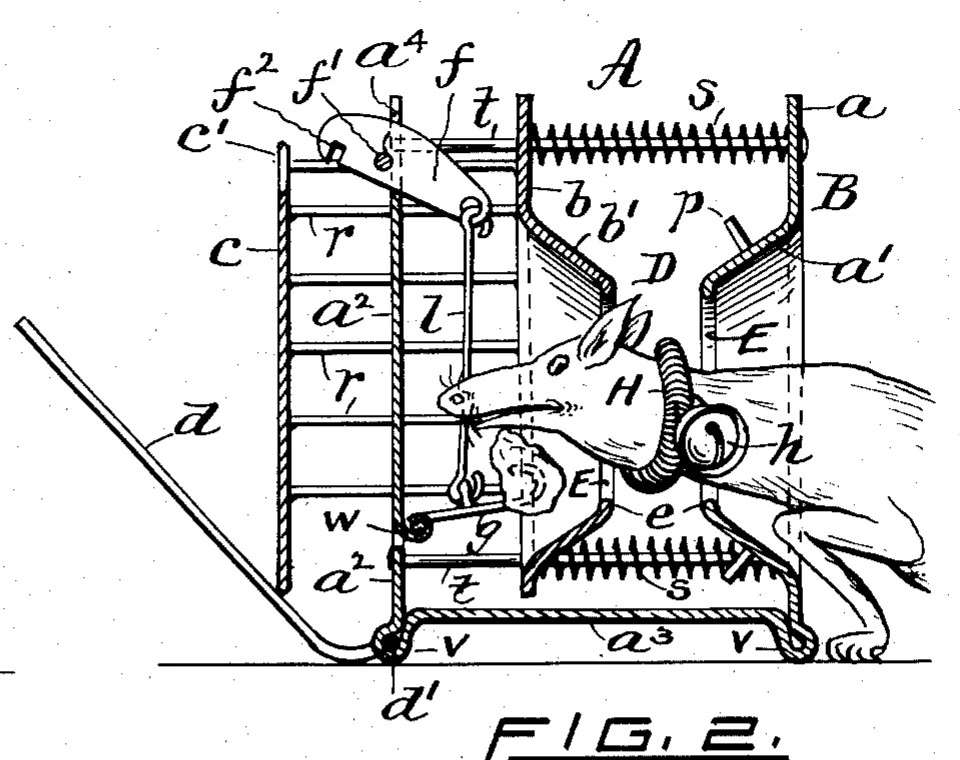
A rat or mouse puts its head through a round opening to reach the bait. The trip springs a frame open, and an elastic collar with small bells snaps round its neck. The animal, they wrote, is “not caught or confined in any manner whatever”. It runs home ringing, “thereby frightening the other rats and causing them to flee”.
What they had in common
A gun, a car and a bell. Each one was a real patent, granted by the same office that granted the snap trap. Each one also had to be set again, by hand, after every animal.
Next, part 24: the government weighs in.
A new part every day. Follow along on YouTube, Instagram, TikTok, Threads or Facebook, or come back to the series.
Sources
- James A. Williams, Animal-Trap, US Patent 269,766, granted 26 December 1882, application filed 21 August 1882: specification, claim and drawing. Google Patents: patents.google.com/patent/US269766A/en
- Allen W. Phillips, Animal-Trap, US Patent 724,931, granted 7 April 1903, application filed 20 November 1902, assigned to the Animal Automobile and Novelty Company of Providence, Rhode Island: specification, claims and drawings (Figs. 1 to 3). Google Patents: patents.google.com/patent/US724931A/en
- Joseph Barad and Edward E. Markoff, Device Employed for Exterminating Rats, Mice, and Other Animals, US Patent 883,611, granted 31 March 1908, application filed 16 December 1907: specification, claims and drawings (Figs. 1 to 5). Google Patents: patents.google.com/patent/US883611A/en