 Mascall Mill
The government weighs in, 1917
Act III: Four hundred years of resetting ·
Listen · 3 min
That's the latest part. Part 27 comes next, with a new part every day: follow along on YouTube, Instagram, TikTok, Threads or Facebook.
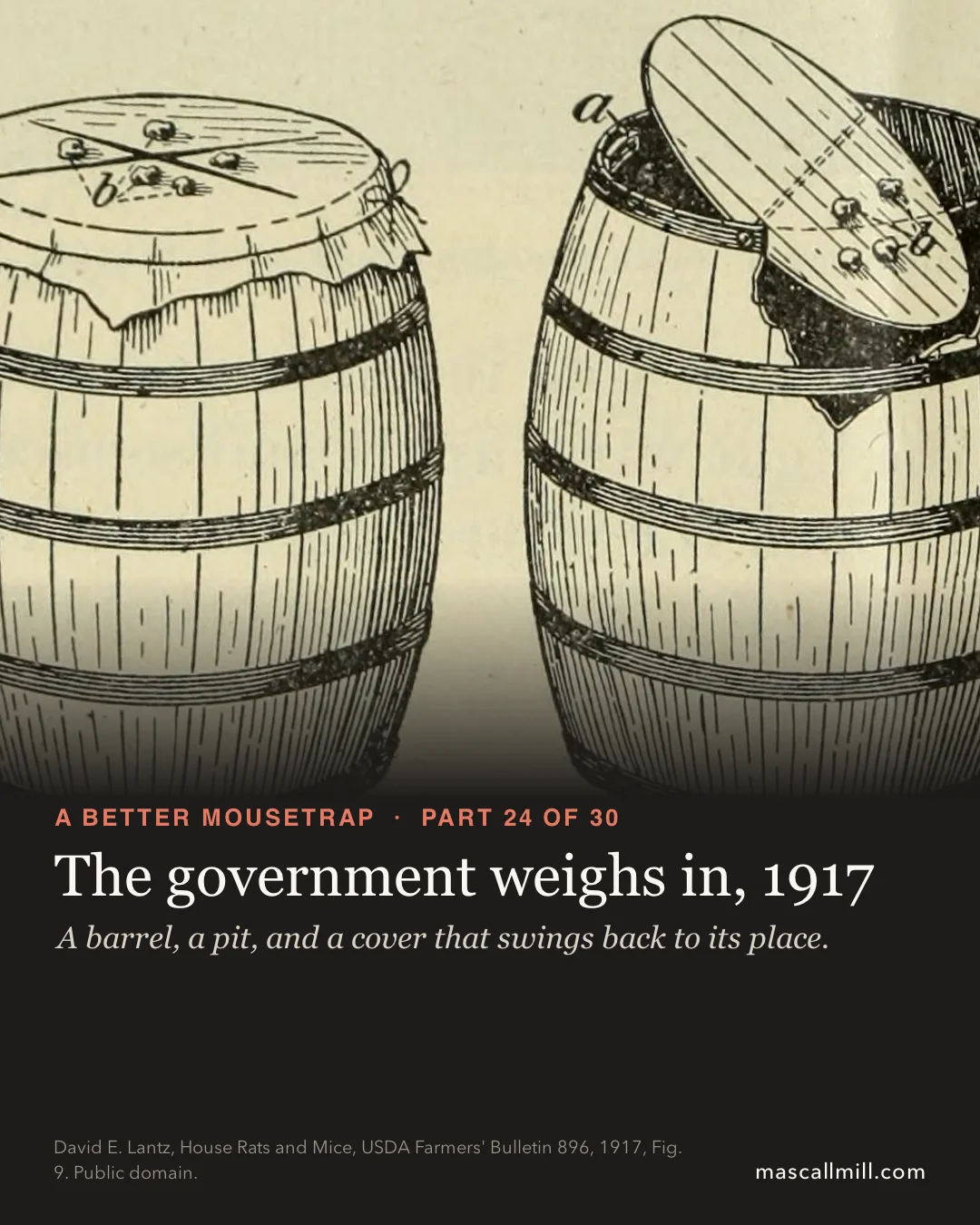
Part 23 ended on three strange patents, each one set again by hand after every animal. In October 1917 the United States government weighed in with advice of its own.
The bulletin
Farmers’ Bulletin 896, House Rats and Mice, came from the Department of Agriculture’s Bureau of Biological Survey. Its author was David E. Lantz, an assistant biologist. It opens with the size of the problem: “In the United States rats and mice each year destroy crops and other property valued at over $200,000,000.”
It then goes through the traps of the day, one by one: guillotine traps, cage traps, steel traps, deadfalls. On which to buy, it is brief: “Probably those made entirely of metal are the best, as they are more durable.” And trapping, it says, “if persistently followed, is one of the most effective ways” to deal with them.
The barrel
Then it turns to an older idea. “About 60 years ago a writer in the Cornhill Magazine gave details of a trap, by means of which it was claimed that 3,000 rats were caught in a warehouse in a single night.”
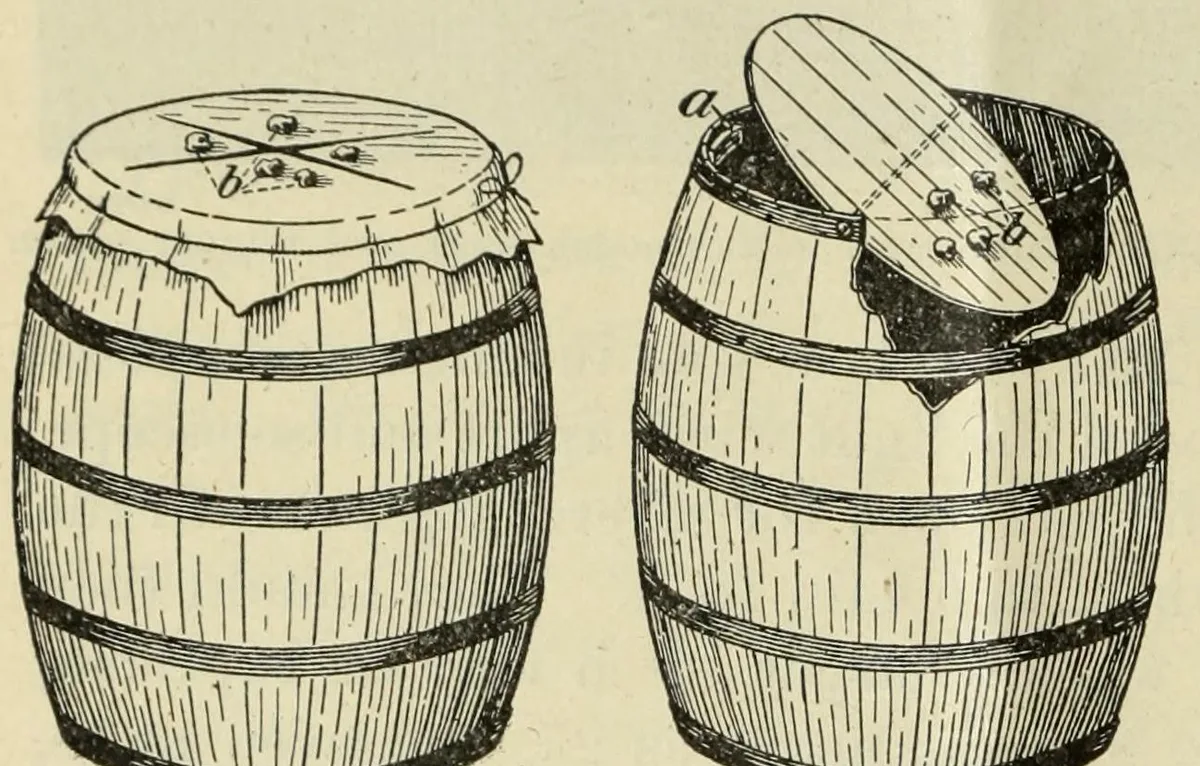
The plan was patient. The rats were fed for several nights on the tops of barrels covered with coarse brown paper. “Afterwards a cross was cut in the paper, so that the rats fell into the barrel.”
Lantz’s verdict: “Many variations of the plan, but few improvements upon it, have been suggested by agricultural writers since that time.” The one the bulletin describes is a barrel “fitted with a light cover of wood, hinged on a rod so as to turn with the weight of a rat”.
The pit
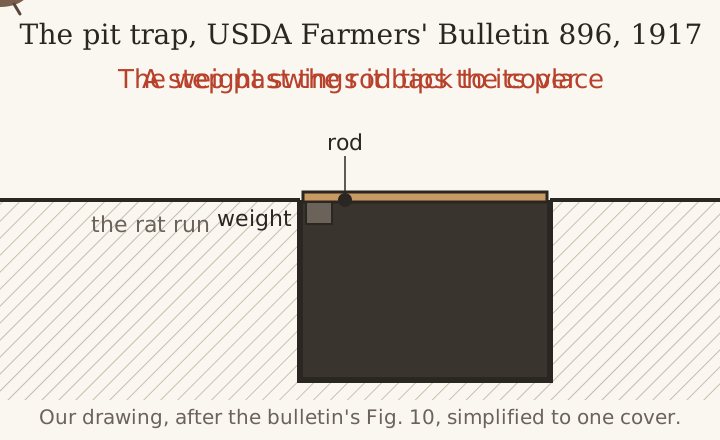
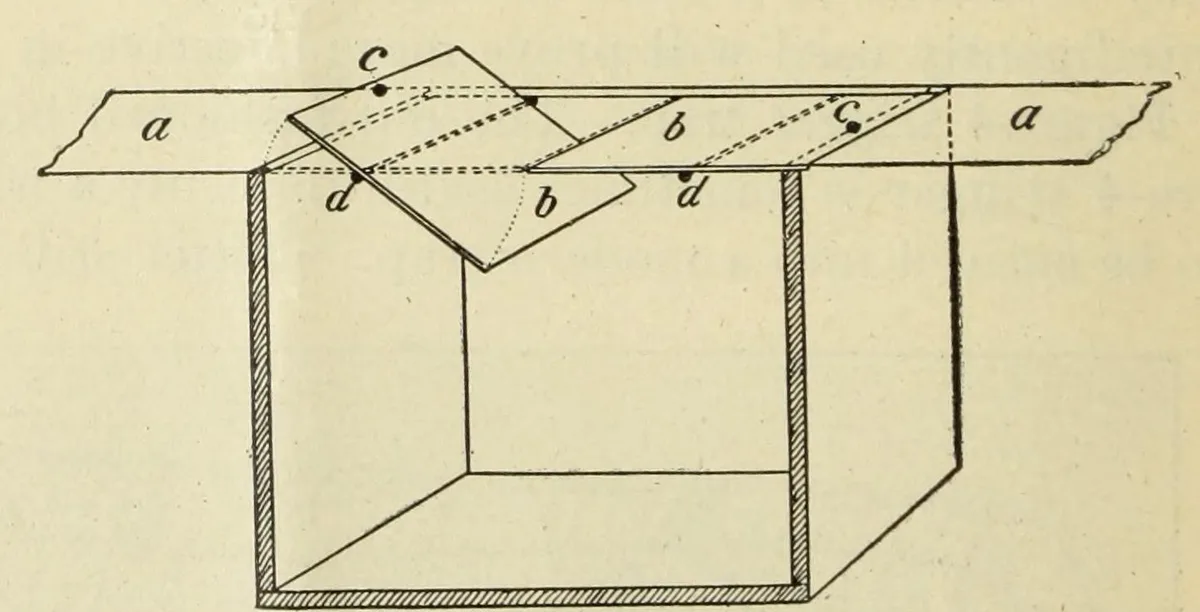
The next trap is “a modification of the barrel trap”: the pit trap. A stout, narrow box is sunk in the ground, its top level with the path the rats run along. The cover is in two sections of light wood or metal. “They turn on rods, to which they are fastened.” Each is weighted near the end of the box, “so adjusted that they swing easily.”
“An animal stepping upon the cover beyond the rods is precipitated into the box, while the cover immediately swings back to its place.”
What it meant
Read that line again: the cover swings back to its place. Nobody has to come and set it. The animal’s own weight turns it, and a weight turns it back.
In part 11, Leonard Mascall’s book of 1590 said the same thing about the mill: “Ye shall make your mill to turne very easely, that the least weight thereon shall turne it.” Three hundred and twenty-seven years later, a government biologist was printing a trap built on that idea, in words that echo his: so adjusted that they swing easily.
Next, part 25: the janitor, 1924.
A new part every day. Follow along on YouTube, Instagram, TikTok, Threads or Facebook, or come back to the series.
Sources
- David E. Lantz, House Rats and Mice, Farmers' Bulletin 896, United States Department of Agriculture, Bureau of Biological Survey, Washington, D.C., October 1917: the yearly loss, the traps, the barrel trap and Fig. 9 (p. 14), the pit trap and Fig. 10 (pp. 14–15). Scan: Internet Archive, archive.org/details/houseratsmice00lant . Text: Project Gutenberg, gutenberg.org/ebooks/35542