 Mascall Mill
The janitor, 1924
Act III: Four hundred years of resetting ·
Listen · 3 min
That's the latest part. Part 27 comes next, with a new part every day: follow along on YouTube, Instagram, TikTok, Threads or Facebook.
Part 24 ended on a government pit trap whose cover swings back to its place. The next trap that set itself came from an Iowa school.
The custodian
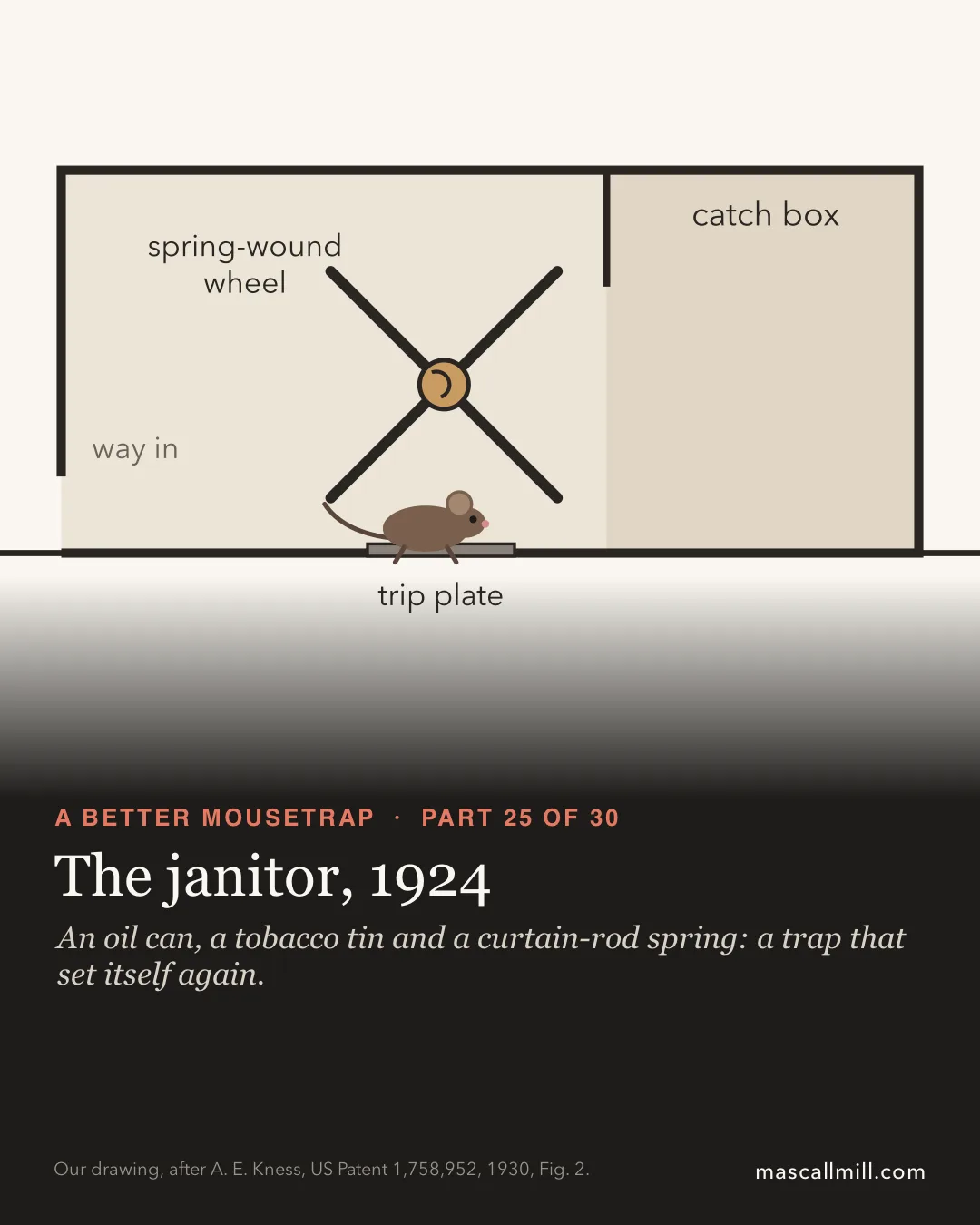
Austin Enos Kness was born in Chadwick, Illinois, in 1889. At 15 he left school and home and headed west. In 1924 he was hired as the custodian at Audubon High School, in Audubon, Iowa. As a 2024 profile in the trade magazine Pest Management Professional puts it, “In this new position, Kness faced a persistent mouse problem.”
He built a trap from what was to hand: “a square oil can, an empty Tuxedo Tobacco tin, a spring from a curtain rod and the wooden base of a crate.” The profile says it caught five mice on its first night.
The patent
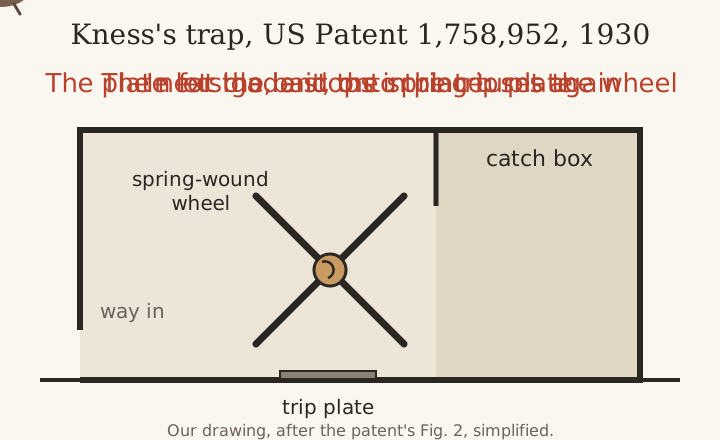
He filed for a patent on November 19, 1927. US Patent 1,758,952, Animal Trap, was granted on May 20, 1930. Its first lines say what he was after: a trap “falling within the general classification of the ever set mechanism. By this is meant a trap that will operate efficiently in the catching of rats, mice and the like rodents without requiring the resetting of the same at each operation of the trap.”
Inside a metal box, the mouse can see the bait through holes in a curved platform, but it can’t reach it. Trying to, it walks onto a trip plate. The plate rocks a lever, and the lever lets go of a wheel of blades. A coil spring round its shaft, wound with a key on the outside of the box, turns the wheel, and a blade sweeps the mouse to the far end of the box. A latch catches the next blade, and the trap is set again.
The mice are thrown “into the other compartments where they are retained fully alive until the trap is empty.”
The company
In 1927 he formed the Kness Manufacturing Co. When the Depression came in 1929, he had to close it. His three sons invested in the business in 1942, and in 1944 he moved the company to Albia, Iowa, into a converted barn. He died in 1974. In 2024, the profile says, Kness Pest Defense was still making “approximately 100,000 Ketch-All traps annually.”
What it meant
The mill in Leonard Mascall’s book of 1590 asked only that “the least weight thereon shall turne it”: the mouse’s own weight does the work. In Kness’s trap the mouse’s weight only trips it, and a wound spring does the rest. Both are traps that nobody has to set again after each mouse. His patent’s name for that, “ever set”, comes back in part 28, about a design from 1590.
Next, part 26: two that never caught a mouse.
A new part every day. Follow along on YouTube, Instagram, TikTok, Threads or Facebook, or come back to the series.
Sources
- Austin Enos Kness, Animal Trap, US Patent 1,758,952, filed November 19, 1927, granted May 20, 1930: the "ever set mechanism", the trip plate, the spring-wound rotating unit and the latch (Figs. 1–4). patents.google.com/patent/US1758952A/en
- Heather Gooch, "PMP Hall of Fame profile: Austin Enos Kness", Pest Management Professional, October 1, 2024: his life, the custodian's job at Audubon High School, the first trap's materials, the company. mypmp.net/?p=97397