 Mascall Mill
Two that never caught a mouse
Act IV: Back to the mill ·
Listen · 4 min
That's the latest part. Part 27 comes next, with a new part every day: follow along on YouTube, Instagram, TikTok, Threads or Facebook.
Part 25 ended on a janitor’s trap that caught mice for real. The two most famous mousetraps of the twentieth century never caught one.
The play
In 1947 the BBC asked Agatha Christie for a radio play for Queen Mary’s 80th birthday. She wrote Three Blind Mice. She turned it into a stage play, and the title had to change. Her son-in-law, Anthony Hicks, found a new one in Hamlet: The Mousetrap, the name Hamlet gives the play he uses to catch a king, as part 12 told.
It opened at the Theatre Royal in Nottingham on October 6, 1952, and at the Ambassadors Theatre in London on November 25, 1952. In March 1974 it closed on a Saturday at the Ambassadors and opened on the Monday next door, at the larger St Martin’s Theatre, so the run never broke. It stopped only on March 16, 2020, when the theatres shut, the first dark night in 68 years, and it came back on May 17, 2021.
It played its 30,000th performance in March 2025. On November 25, 2026, it enters its 75th year. After each performance, the audience is asked to keep the ending a secret.
Hamlet’s mousetrap was a play that caught a guilty king. Christie’s is a play about catching a murderer. Neither one has a spring.
The game
In 1963 the Ideal toy company brought out the Mouse Trap game. It was designed by Marvin Glass and Associates in Chicago, and the Strong National Museum of Play says its machine is based on the drawings of the cartoonist Rube Goldberg.
On August 24, 1962, Marvin Glass and Gordon Barlow had filed for a patent on a “Game with action producing components”. US Patent 3,298,692 was granted on January 17, 1967. Its object was a game where “the playing pieces simulate animals, and specifically mice,” and “a mouse will be caught in a cage or trap.”
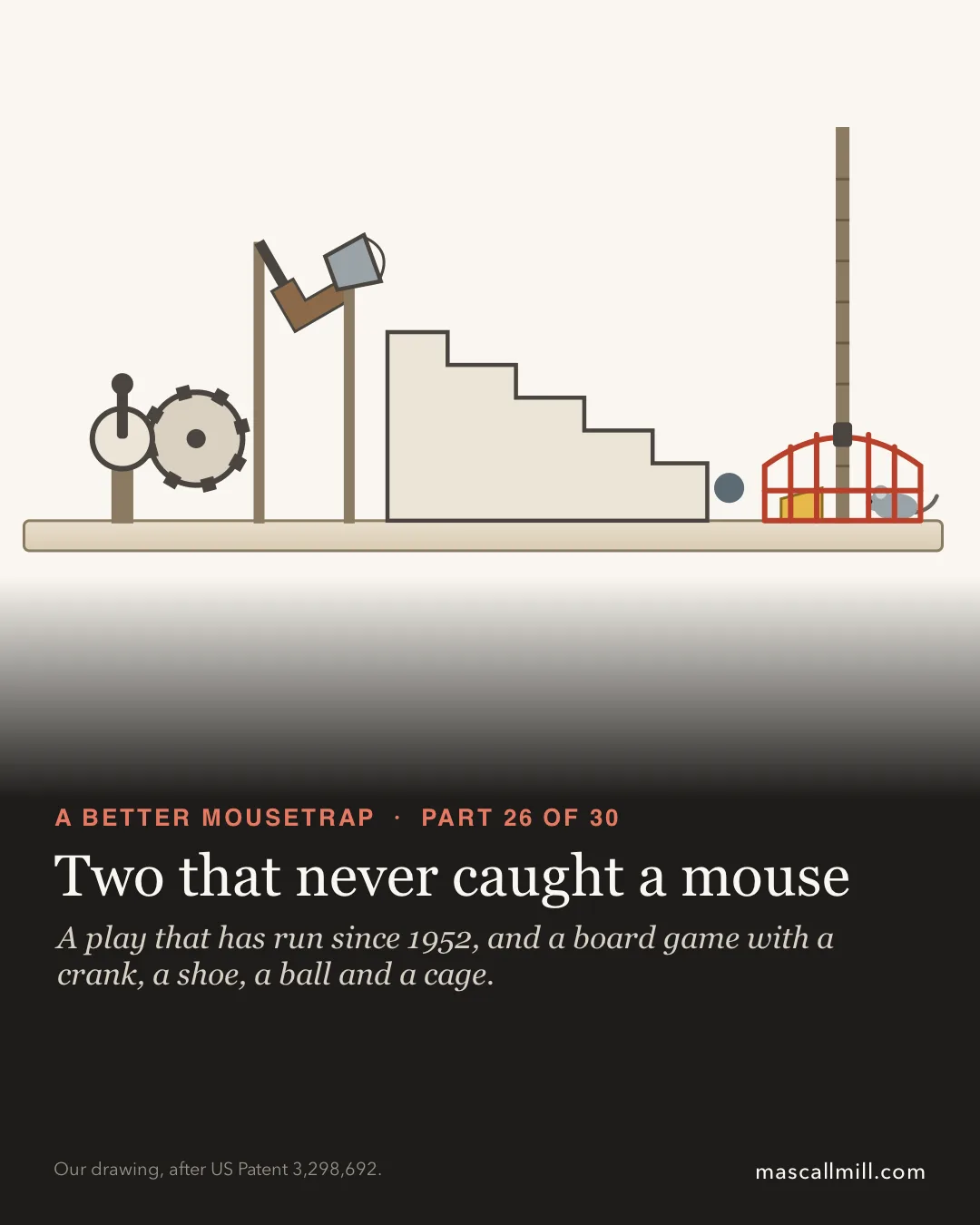
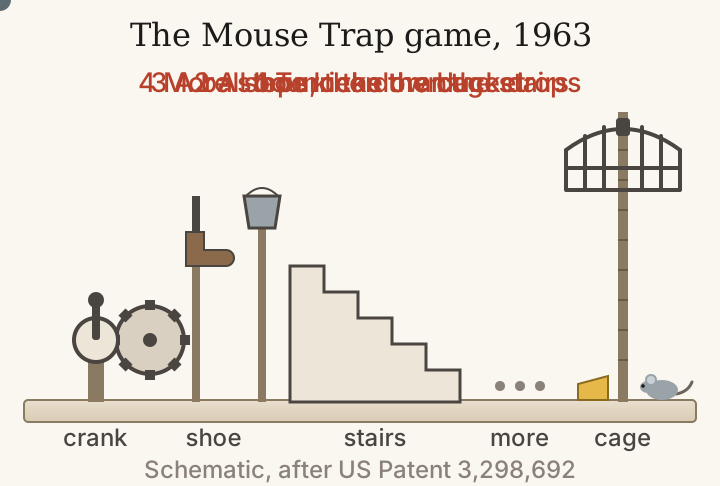
The patent walks through the machine one part at a time. A crank turns two gears. A finger on the second gear swings a lever with a stop sign on the end, and the stop sign hits a shoe hanging from a light pole, “causing it to swing violently.” The shoe kicks a bucket on the landing at the top of a stairway, and the heavy metal ball in the bucket bounces down the steps into a rain gutter. The ball hits a push rod and raises a hand. The hand frees a bowling ball, which drops through a hole in a bath tub onto the end of a diving board, and a diver flies off the board into a wash tub.
The wash tub sits on a platform with a tall mast. A cage hangs at the top, set so it comes loose “upon any substantial disturbance” of the mast, “as when diver 154 lands in the wash tub 158.” Teeth slow the cage’s fall, which, the patent says, will “add to the amusement.” Then the last line of the chain:
Cage 176 will then slide down mast 164 and enclose cheese 168 and catch mouse 170.
The patent calls it a simulated mouse. It also admits that “with so many actions taking place, each dependent on the one before, there is a good chance that one of them may fail from time to time.”
What they kept
Mascall’s mill in 1590 had one moving part, and the mouse’s own weight moved it. To drop its cage once, the game needs a crank, two gears, a lever, a shoe, a bucket, two balls, a hand, a diving board and a diver. It’s a trap built to be watched.
The play kept the word, and the game kept the machine. Next, part 27 goes back to the animal itself: what a mouse actually does.
A new part every day. Follow along on YouTube, Instagram, TikTok, Threads or Facebook, or come back to the series.
Sources
- The Mousetrap, official site, About: the premiere at the Theatre Royal, Nottingham, on October 6, 1952, the London opening at the Ambassadors Theatre on November 25, 1952, the move next door to St Martin's Theatre in March 1974, the dark night of March 16, 2020 and the reopening of May 17, 2021. themousetrap.com/about/
- Agatha Christie Limited, Three Blind Mice (the 1947 radio play for Queen Mary's 80th birthday): agathachristie.com/stories/three-blind-mice . The Mousetrap, the facts (the radio origin and the request to keep the secret): agathachristie.com/news/2019/agatha-christies-the-mousetrap-the-facts . The title from Hamlet: agathachristie.com/en/stories/the-mousetrap
- London Theatre, "The Mousetrap celebrates 30,000 performances in the West End", March 2025: londontheatre.co.uk/theatre-news/news/the-mousetrap-celebrates-30-000-performances-in-the-west-end . WhatsOnStage, October 22, 2026, on the 75th year from November 25, 2026: whatsonstage.com/news/the-mousetrap-announces-new-cast-director-design-and-refurbishment-as-it-prepares-for-its-75th-anniversary_1735704/
- Marvin I. Glass and Gordon A. Barlow, Game with Action Producing Components, US Patent 3,298,692, filed August 24, 1962, granted January 17, 1967, assigned to Marvin Glass & Associates, Chicago: every quotation from the patent and the order of the machine. patents.google.com/patent/US3298692A/en
- Victoria and Albert Museum, Mouse Trap Game, O1599936 (first published by Ideal in 1963): collections.vam.ac.uk/item/O1599936/mouse-trap-game-board-game-hank-kramer/ . The Strong National Museum of Play, Mouse Trap Game, 93.812 (designed by Marvin Glass and Associates for Ideal, after Rube Goldberg's drawings): artsandculture.google.com/asset/mouse-trap-game-marvin-glass-associates-and-ideal-novelty-and-toy-co/2QFWMd_bmRJ6Tg