 Mascall Mill
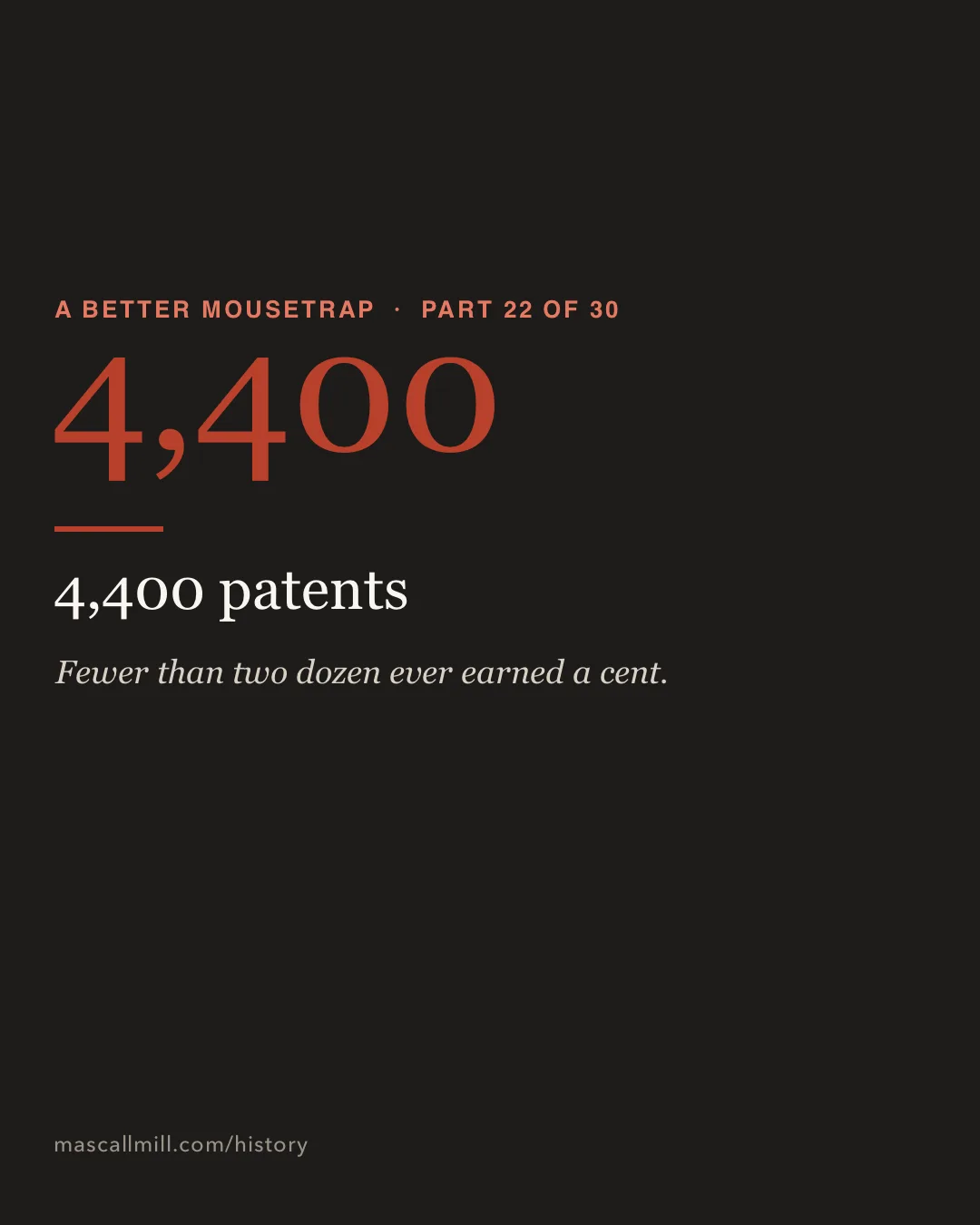
4,400 patents
Act III: Four hundred years of resetting ·
Listen · 2 min
That's the latest part. Part 23 comes next, with a new part every day: follow along on YouTube, Instagram, TikTok, Threads or Facebook.
Part 21 ended with John Mast’s patent of 1903, a trap made safer to set. It was one patent among a great many. By the time a magazine counted them, there were thousands.
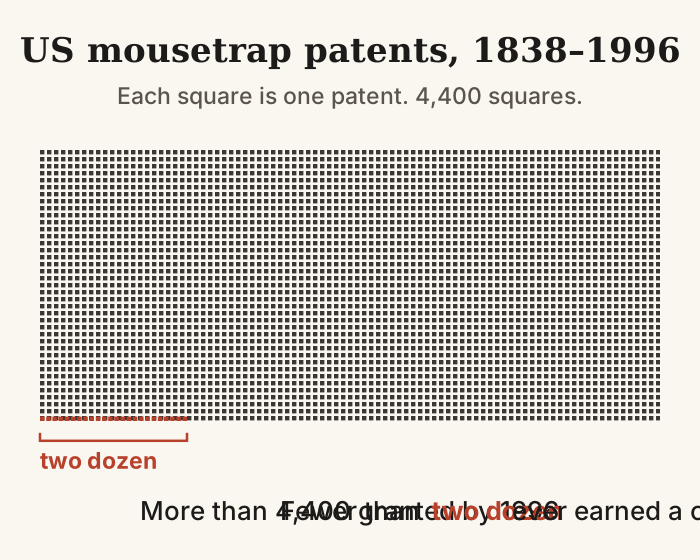
More than 4,400
In October 1996, Jack Hope wrote the history of the mousetrap for American Heritage. “Since it first opened for business in 1838,” he wrote, “the U.S. Patent Office reports that it has granted more than 4400 mousetrap patents, 95 percent of them to amateur inventors.”
Forty a year, every year
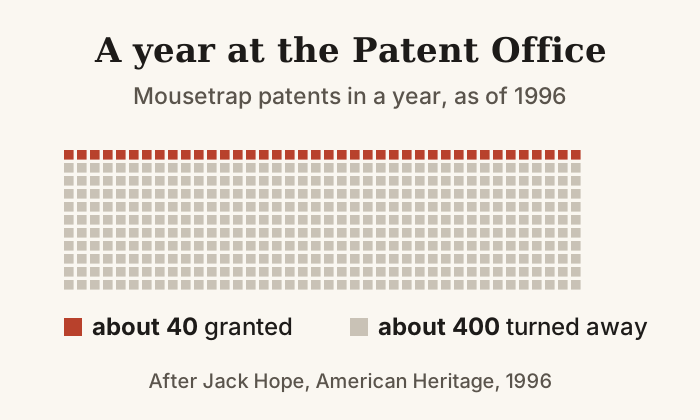
They kept coming. “Roughly forty new mousetrap patents are granted each year, every year,” Hope wrote, “and ten times that many mousetrap patent applications are turned away.”
A menu of subclasses
The Patent Office sorted them into “thirty-nine official subclasses.” Hope lists some of their names: “Impaling,” “Smiting,” “Swinging Striker,” “Nonreturn Entrance,” “Choking or Squeezing,” “Constricting Noose” and “Electrocuting and Explosive.”
To be granted, a trap didn’t have to be good. Hope notes that the Patent Office “does not require that a device be practical or efficient.” It “requires merely that it will do more or less what the inventor claims it will do.”
Fewer than two dozen
Of the more than 4,400 mousetraps patented in US history, Hope wrote, “fewer than two dozen have ever earned their creators a cent in the marketplace.”
He also named what sank the rest. At the turn of the century, he wrote, “the three great truths of unsuccessful mousetrap design—excess complexity, excess gore, and excess price” had already been shown by “the commercial failure of all but a handful of the thousand or so patented traps already in existence.”
Thousands of inventors had tried. A few traps sold.
Next, part 23: the strangest ones.
A new part every day. Follow along on YouTube, Instagram, TikTok, Threads or Facebook, or come back to the series.
Sources
- Jack Hope, "A Better Mousetrap", American Heritage, vol. 47 no. 6, October 1996: americanheritage.com/better-mousetrap . The patent counts, the subclass names, what the Patent Office requires, the "three great truths" and "fewer than two dozen" are all from it.