 Mascall Mill
Mind your fingers, 1903
Act III: Four hundred years of resetting ·
Listen · 3 min
That's the latest part. Part 23 comes next, with a new part every day: follow along on YouTube, Instagram, TikTok, Threads or Facebook.
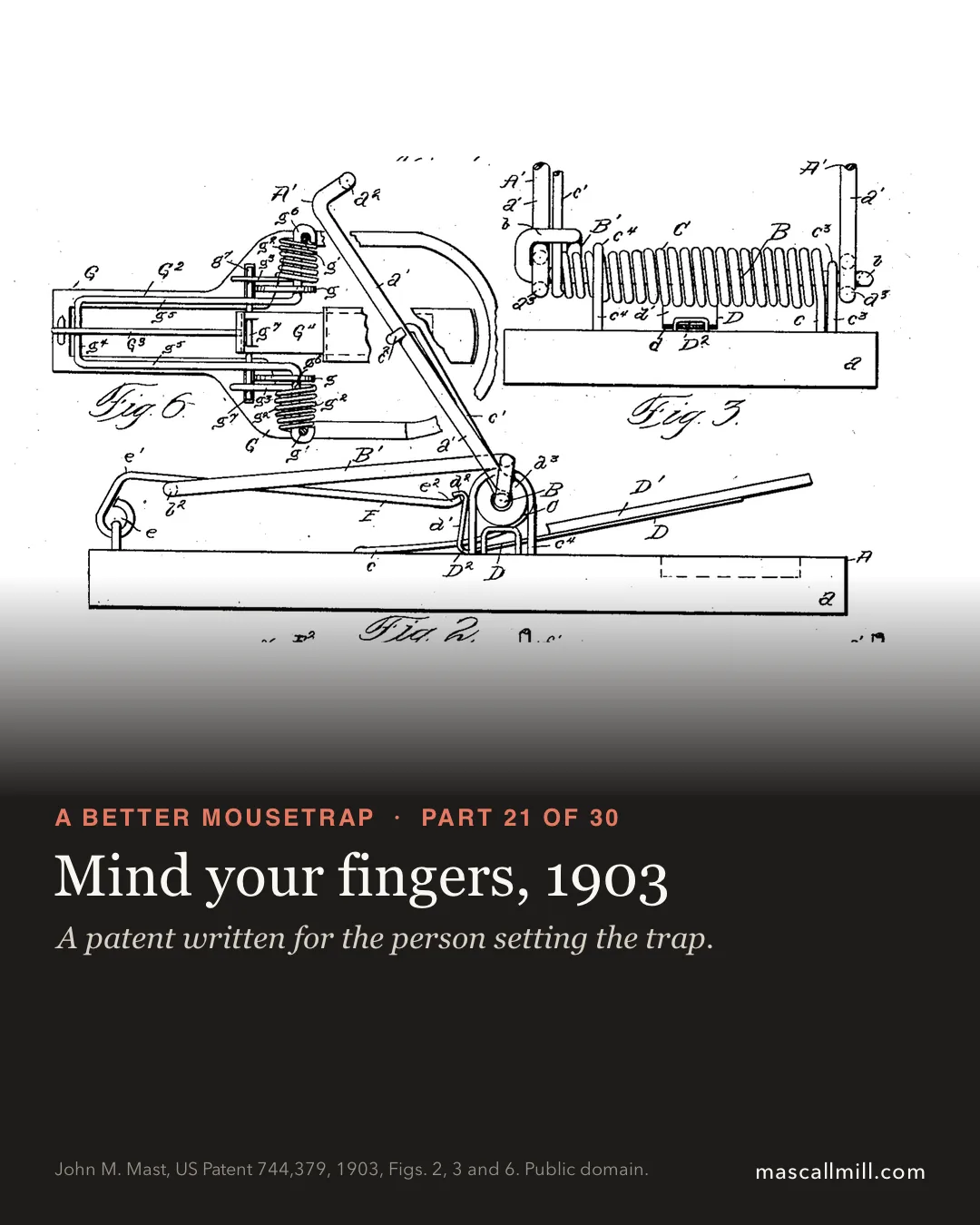
Part 20 ended in Leeds, with a trigger a mouse only had to walk across. Every trap since Hooker’s in part 19 ends the same way: someone pulls the wire back against the spring and hooks it, by hand. In Pennsylvania, a patent was written about that moment.
The patent
On 30 October 1899, John M. Mast of Lancaster, Pennsylvania, applied for a US patent for an “Animal-Trap”. It was granted on 17 November 1903 as patent 744,379, assigned to the J. M. Mast Manufacturing Company of Lititz.
Fingers
The patent says what it was for: a trap that could be “readily set or adjusted with absolute safety to the person attending thereto.” The danger it names is the setter “having his fingers caught or injured by the striker when it is prematurely or accidentally freed.”
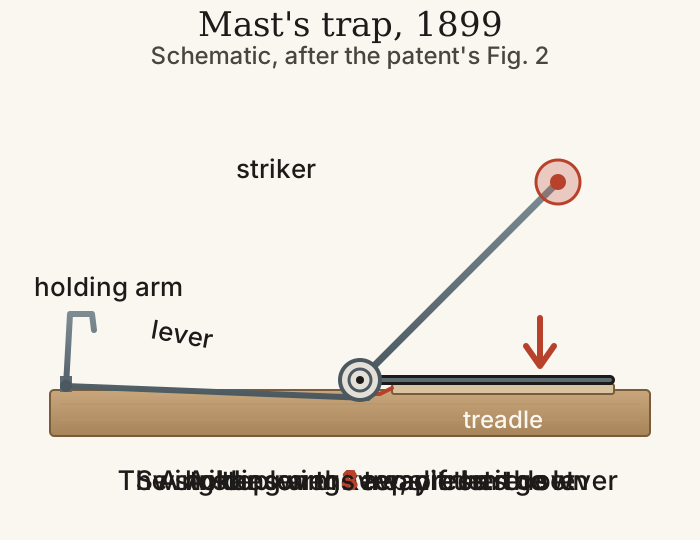
So in Mast’s trap the striker is “raised by depressing the outer end of a lever or arm rigid with a rotatable shaft.” The lever runs from the spring’s shaft to the far end of the base. Press its end down and the striker swings up and back. A holding arm, pivoted at that end of the base, lies over the lever and “serves to hold said lever-arm in depressed position”. Its other end hooks under a lip on the trigger. The trigger is a treadle, and the trap is sprung “by tripping said treadle or trigger.”
A factory already running
Jack Hope’s history of the mousetrap, in American Heritage in 1996, says Mast’s three-story brick factory in Lititz “manufactured the curious combination of coleslaw, wooden fishing lures, and popcorn.” What Mast had, Hope wrote, was “an already existing factory and a crude kind of assembly line”, with workers “who could readily be taken away from cabbage shredding and put into wire bending.”
Hope says Mast was selling the trap “even before his U.S. patent was officially granted in 1903”, and that it was still made, in 1996, under “the trade name Victor.”
Hope calls it the John Mast snap trap. The one-piece wire spring and jaw were already in Hooker’s patent of 1894. What Mast’s patent is about is setting it.
Safer, not gone
More than 300 years after Mascall’s book, the hard part of a mousetrap was still the resetting. Mast’s patent made it safer for the person doing it. It still had to be done, by hand, after every mouse.
Next, part 22: 4,400 patents.
A new part every day. Follow along on YouTube, Instagram, TikTok, Threads or Facebook, or come back to the series.
Sources
- John M. Mast, Animal-Trap, US Patent 744,379, granted 17 November 1903, application filed 30 October 1899 (Serial No. 735,148), assigned to the J. M. Mast Manufacturing Company of Lititz, Pennsylvania: specification, claims and drawings. Google Patents: patents.google.com/patent/US744379A/en . The patent quotes on this page are from it.
- Jack Hope, "A Better Mousetrap", American Heritage, vol. 47 no. 6, October 1996: americanheritage.com/better-mousetrap . The quotes about Mast's factory, his selling before the grant, and the Victor name are from it.