 Mascall Mill
Leeds, 1899
Act III: Four hundred years of resetting ·
Listen · 2 min
That's the latest part. Part 23 comes next, with a new part every day: follow along on YouTube, Instagram, TikTok, Threads or Facebook.
Part 19 ended on Hooker’s snap trap, sprung by a touch on a small baited trigger at the front. Four years later, in Leeds, a trap maker made the trigger bigger.
The patent
On 30 December 1898, James Henry Atkinson of Leeds applied for British patent 27,488, for an “Improved Treadle Trap for Mice, Rats and the like.” It was published on 4 March 1899.
Atkinson is remembered as a Leeds ironmonger. By the 1911 census he was down as an “Animal Trap Maker”, and an employer.
A treadle, not a trigger
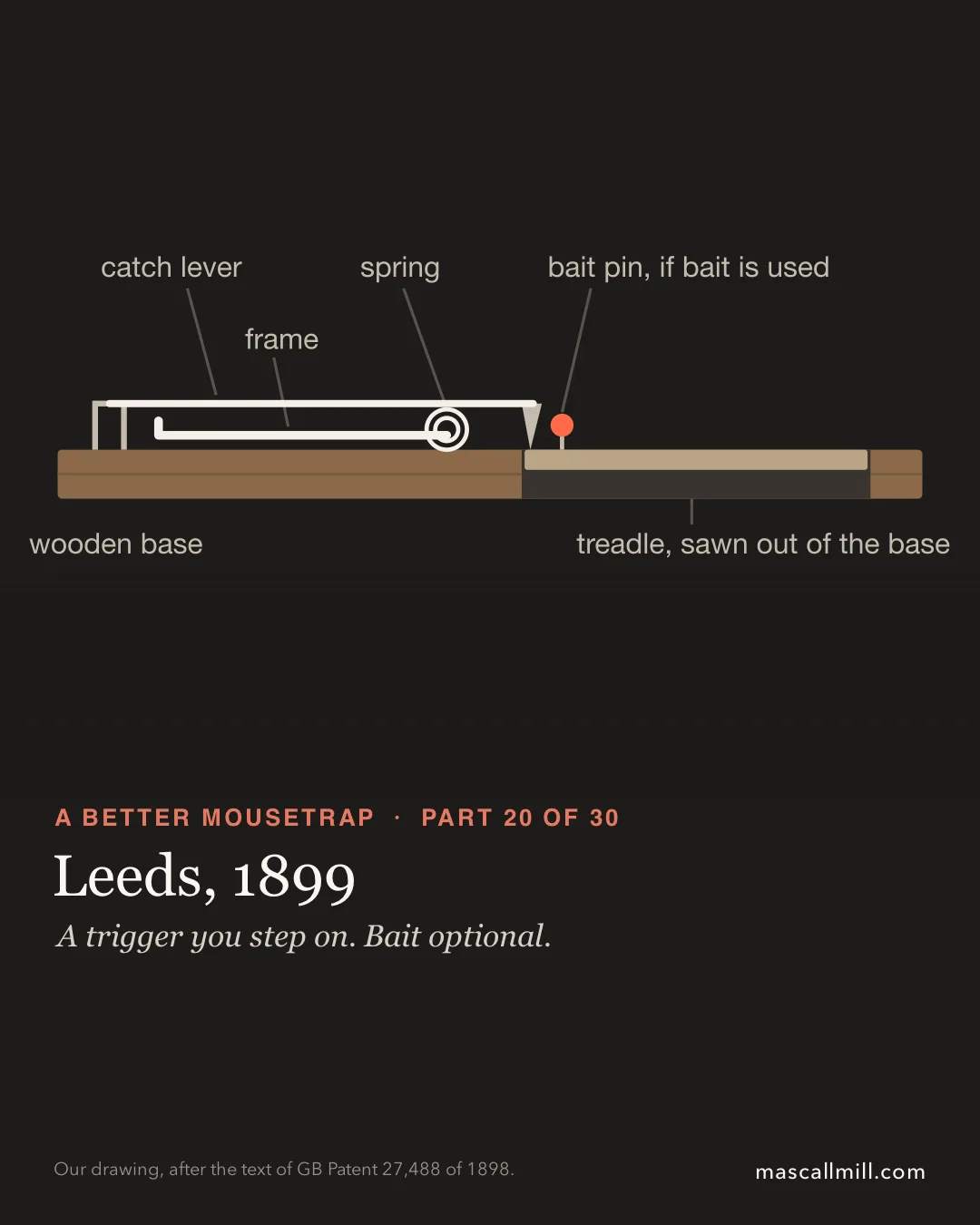
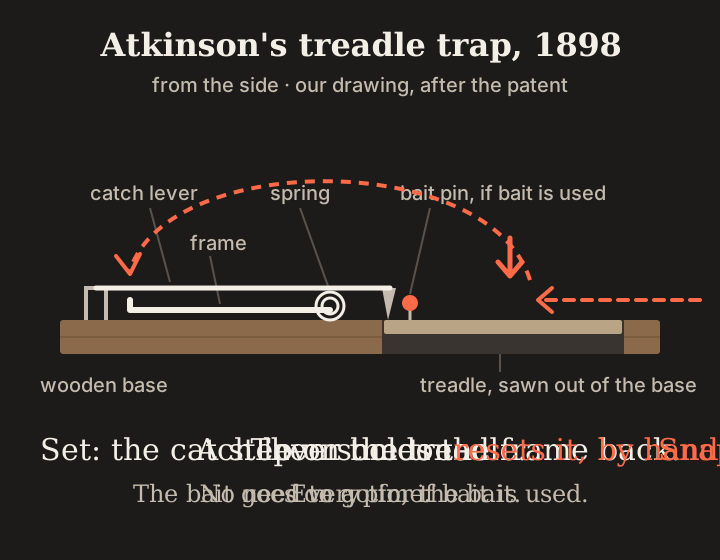
Hooker had wanted his trap “sprung by the animal passing over it when not attracted by the bait”, but his trigger was a small plate with the bait on it. Atkinson’s is a treadle: a flat plate “formed by sawing a suitable piece out of the base”, and loosely hinged so a mouse’s weight tips it.
The bait goes on a small wire pin at the treadle’s hinge, which “acts as a bait pin when bait is employed.” When, not always.
Behind it is the same idea as Hooker’s, one piece of wire: “The frame l is formed in one with the coiled spring k, the ends of which are secured in the base board a.”
The Little Nipper in the Museum of English Rural Life, made in Leeds in 1899, has its treadle cut across the full width of the base. A mouse doesn’t have to take the bait. It only has to walk across.
The Little Nipper
Atkinson named it the Little Nipper and asked Procter Brothers, a Leeds wireworks, to make it for him. In 1913 they bought the rights from him, and they kept making it.
Still one at a time
A wider treadle catches the mouse that ignores the bait. It doesn’t change what happens next: one mouse, and then someone has to come and set it again.
Next, part 21: mind your fingers.
A new part every day. Follow along on YouTube, Instagram, TikTok, Threads or Facebook, or come back to the series.
Sources
- James Henry Atkinson, Improved Treadle Trap for Mice, Rats and the like, GB Patent 27,488 of 1898, applied 30 December 1898, published 4 March 1899. Google Patents: patents.google.com/patent/GB189827488A/en . The patent quotes on this page are from it.
- Museum of English Rural Life, object 2008/36, 'Little Nipper' mouse trap, designed by James Henry Atkinson of Leeds, made by Procter Brothers, Leeds, 1899, citing patent No. GB27488: reading.ac.uk/adlib/Details/collect/16914
- Grace's Guide, Procter Brothers (Atkinson asked Procters to make the trap; the rights bought in 1913) and James Henry Atkinson (1849–1942; a Leeds ironmonger; the 1911 census lists him as an animal trap maker): gracesguide.co.uk/Proctor_Brothers , gracesguide.co.uk/James_Henry_Atkinson . The two pages give different prices for the 1913 sale, so this page gives none.