 Mascall Mill
One piece of wire, 1894
Act III: Four hundred years of resetting ·
Listen · 2 min
That's the latest part. Part 20 comes next, with a new part every day: follow along on YouTube, Instagram, TikTok, Threads or Facebook.
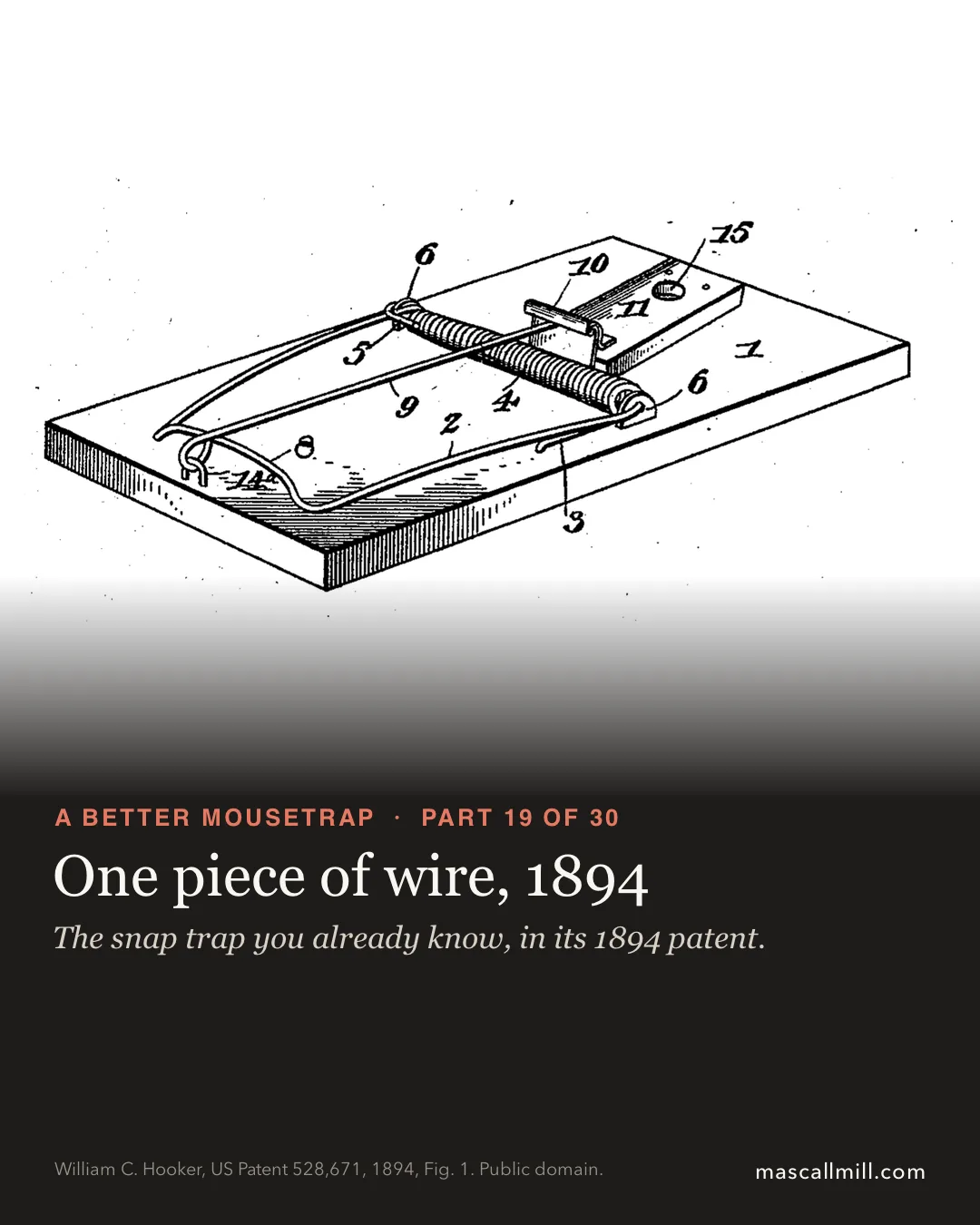
Part 18 was a sentence about a better mousetrap. Twelve years after a newspaper printed it, a man in Illinois was granted a patent for a new one.
The patent
On 6 November 1894, William C. Hooker of Abingdon, Illinois, was granted US patent 528,671, for an “Animal-Trap”. He had applied that March.
He said what he was after in the first lines: “for catching mice and rats, a simple, inexpensive and efficient trap”, one that could sit by a rat-hole and be “sprung by the animal passing over it when not attracted by the bait.”
One piece of wire
The base is a flat board, “preferably constructed of wood”. Across it sits the part the patent is built on: a single piece of springy wire, bent into an arm, coiled into a spring, and carried on into a loop that is the jaw.
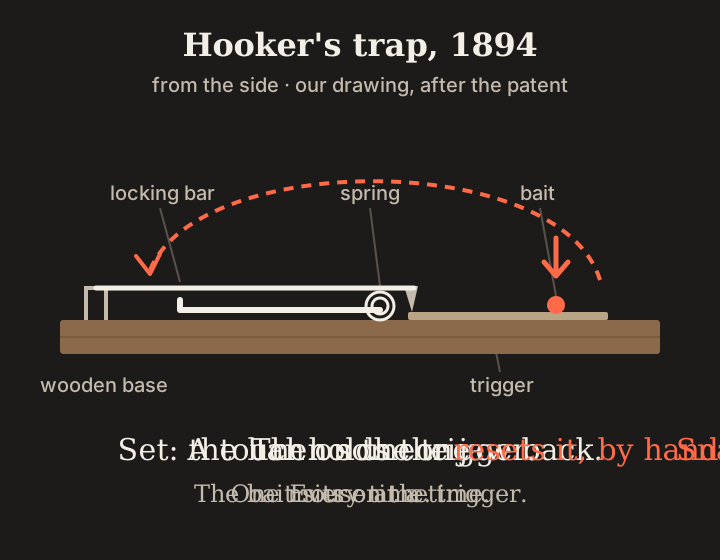
To set it, you swing the jaw back against the spring and hold it there with a locking bar. The far end of the bar is held by a small catch on a trigger at the front, and the trigger has a hole for the bait. A mouse can’t reach the bait without touching the trigger, and “the slightest pressure on the trigger will cause the springing of the trap.”
The patent even gives the easy way to set it: turn the trap upside down, lay the end of the bar over the catch, and the catch takes hold of it by itself.
The trap you already know
Put Hooker’s drawing beside a wooden snap trap from a hardware store today and the parts line up: board, coiled spring, wire jaw, locking bar, baited trigger. It’s cheap, it’s quick, and it fits beside a mouse hole.
It does one mouse at a time. Then someone has to come and set it again, by hand, for the next one.
That’s the problem this series keeps coming back to: every trap has to be reset. Mascall’s mill had answered it in 1590, and two inventors again in 1861. Hooker’s trap didn’t try to.
Next, part 20: Leeds.
A new part every day. Follow along on YouTube, Instagram, TikTok, Threads or Facebook, or come back to the series.
Sources
- William C. Hooker, Animal-Trap, US Patent 528,671, granted 6 November 1894, application filed 14 March 1894 (Serial No. 503,629): specification, claims and drawings (Figs. 1 to 3). Google Patents: patents.google.com/patent/US528671A/en . Every quote on this page is from it.