 Mascall Mill
The Greeks fear it, the Romans name it
Act I: The problem ·
Listen · 3 min
That's the latest part. Part 20 comes next, with a new part every day: follow along on YouTube, Instagram, TikTok, Threads or Facebook.
We’re Mascall Mill, and this series ends with the trap we build: our version of Leonard Mascall’s 1590 trap, which resets itself. See it work.
Part 4 ended with a box and a door, and nobody at Lahun wrote down what it was for. The next time a trap turns up, it is in writing.
Two fears, and a third
The Battle of Frogs and Mice is a Greek mock epic: Homer’s kind of war, fought by frogs and mice. It was long credited to Homer himself, but it was probably written long after him.
Early on, a mouse called Crumb-snatcher brags that he has never shrunk from a fight. He’ll nip a sleeping man’s toe and never wake him. Then he admits what does scare him: “There are two things I fear above all else the whole world over, the hawk and the ferret, for these bring great grief on me, and the piteous trap wherein is treacherous death.”
He says two, then names three. The third is the one with no animal in it. The poet doesn’t stop to explain the trap. He expects his listeners to know one.
A word for it
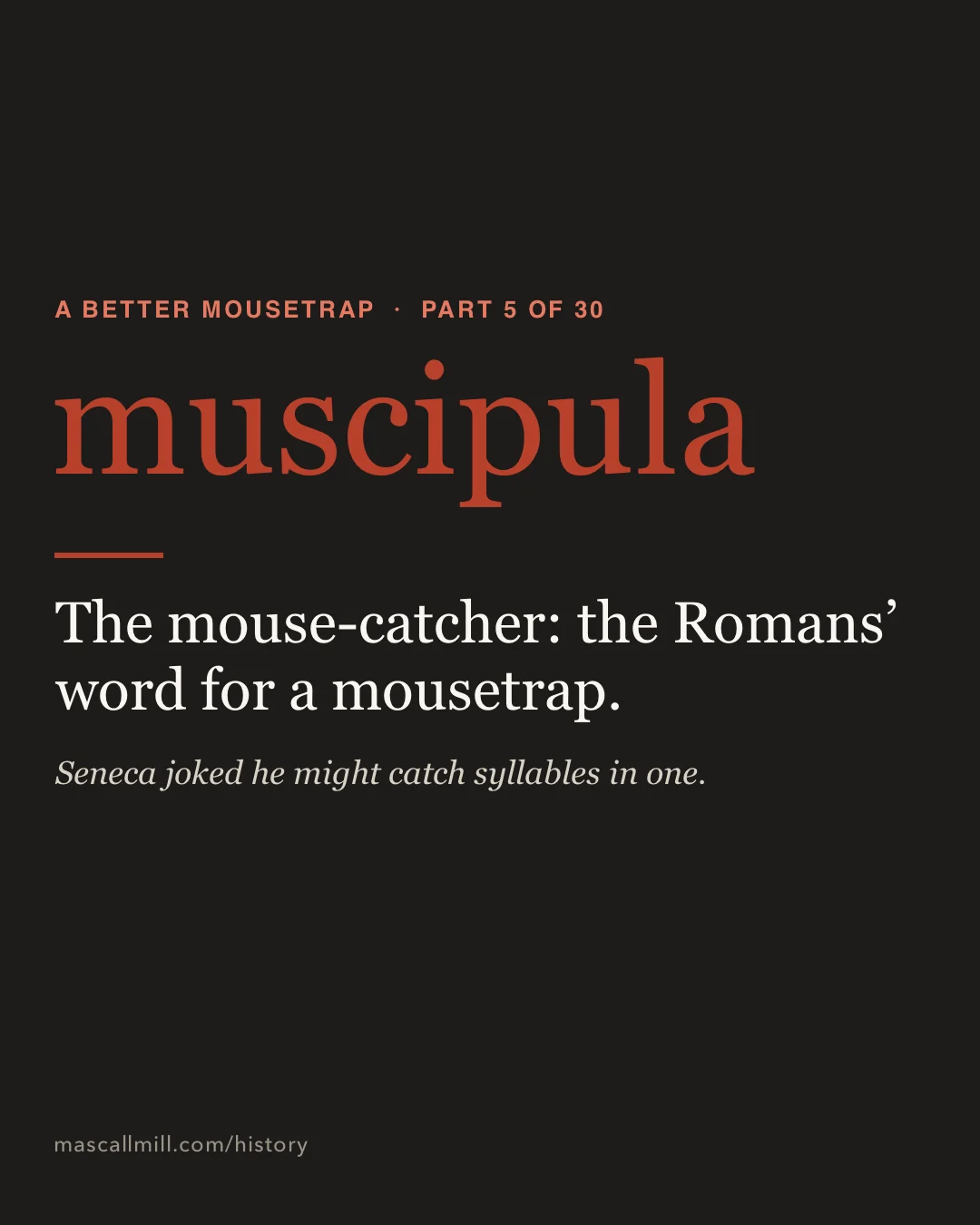
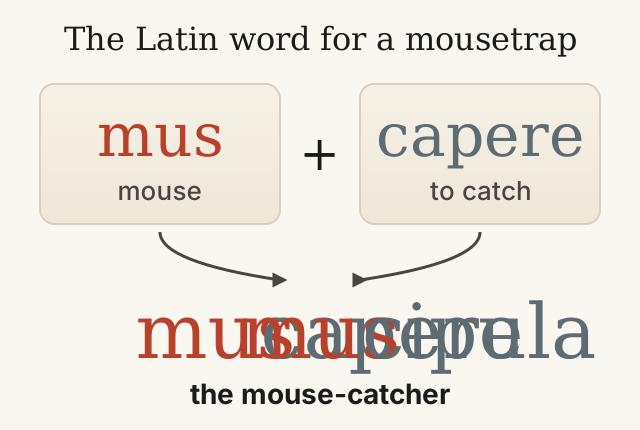
Latin gave the thing its own word: muscipula, from mus, mouse, and capere, to catch. The mouse-catcher.
It’s old. Lucilius, a Roman satirist of the second century BC, wrote of someone who had often escaped snares and mousetraps.
Seneca’s joke
In the 60s AD the philosopher Seneca wrote a long run of letters to his friend Lucilius, a different Lucilius. In letter 48 he goes after logicians who spend their lives on trick arguments, and he gives one as an example:
“‘Mouse’ is a syllable. Now a mouse eats cheese; therefore, a syllable eats cheese.”
Then he pretends to be worried. “Without doubt I must beware, or some day I shall be catching syllables in a mousetrap, or, if I grow careless, a book may devour my cheese!”
Seneca’s point was that puzzles like this waste a life. Ours is smaller. A Roman writer could make a mousetrap the punchline and expect the joke to land.
So by now the trap is ordinary: a fear in a poem, a word in the dictionary, a prop in a joke. Soon it stands for something much bigger.
Next, part 6: the devil’s mousetrap.
A new part every day. Follow along on YouTube, Instagram, TikTok, Threads or Facebook, or come back to the series.
Sources
- The Battle of Frogs and Mice (Batrachomyomachia), tr. Hugh G. Evelyn-White, in Hesiod, the Homeric Hymns and Homerica (Loeb, 1914). Public domain. sacred-texts.com/cla/homer/frogmice.htm
- Lewis, C. T. and Short, C. (1879). A Latin Dictionary: muscipula, muscipulum (mus + capio), citing Lucilius and Seneca. alatius.com/ls/index.php?l=muscipula
- Seneca, Epistulae Morales 48.6. Latin text: thelatinlibrary.com/sen/seneca.ep5.shtml . English: Moral Letters to Lucilius, tr. Richard M. Gummere (Loeb, 1917), Letter 48. Public domain. en.wikisource.org/wiki/Moral_letters_to_Lucilius/Letter_48