 Mascall Mill
The devil's mousetrap
Act I: The problem ·
Listen · 2 min
That's the latest part. Part 20 comes next, with a new part every day: follow along on YouTube, Instagram, TikTok, Threads or Facebook.
Part 5 left the mousetrap an ordinary thing: a fear in a poem, a word in the dictionary, a prop in a joke. Ordinary things are what preachers reach for.
A sermon for the Ascension
Augustine was bishop of Hippo, a port town in North Africa, from 395 until his death in 430. He preached often, and hundreds of his sermons survive.
Sermon 263 is for the feast of the Ascension, forty days after Easter. In it he asks what Christ’s death did to the devil.
The bait
“The devil exulted when Christ died, and by that very death of Christ the devil was beaten. He took the bait, as in a mousetrap.”
Then comes the line people still quote, in Latin:
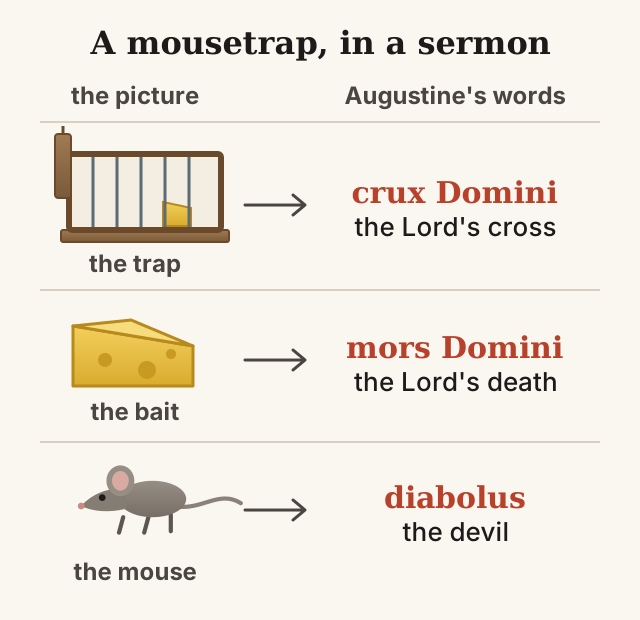
“Muscipula diaboli, crux Domini; esca qua caperetur, mors Domini.”
The devil’s mousetrap, the Lord’s cross. The bait that caught him, the Lord’s death.
Why a mousetrap
The word is muscipula, the mouse-catcher from part 5. Augustine doesn’t explain it. He expects every listener to know how a trap works: the animal comes for the food, and the food is what catches it.
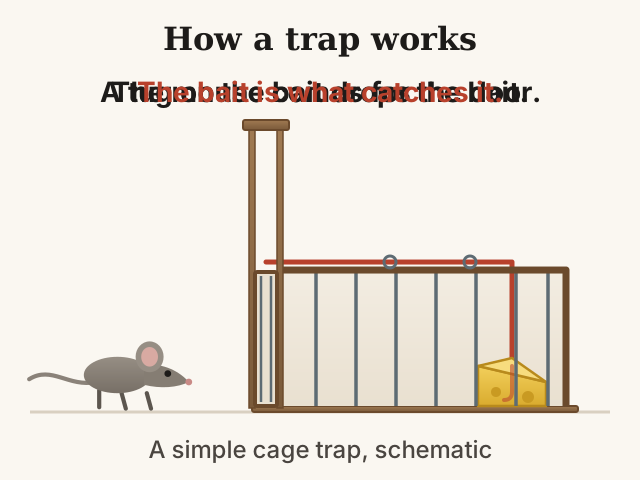
His whole point hangs on that. The devil gets what he wanted, a death, and getting it is what beats him. A trap needs no strength. It waits, and lets the mouse do the rest.
The picture outlived him. About a thousand years later it may turn up in a painting, on a carpenter’s bench.
Next, part 7: Joseph’s workshop.
A new part every day. Follow along on YouTube, Instagram, TikTok, Threads or Facebook, or come back to the series.
Sources
- Augustine of Hippo, Sermo 263 (De quadragesima Ascensionis Domini), section 2. Latin text: augustinus.it/latino/discorsi/discorso_367_testo.htm . English translation ours.