 Mascall Mill
Joseph's workshop
Act I: The problem ·
Listen · 2 min
That's the latest part. Part 20 comes next, with a new part every day: follow along on YouTube, Instagram, TikTok, Threads or Facebook.
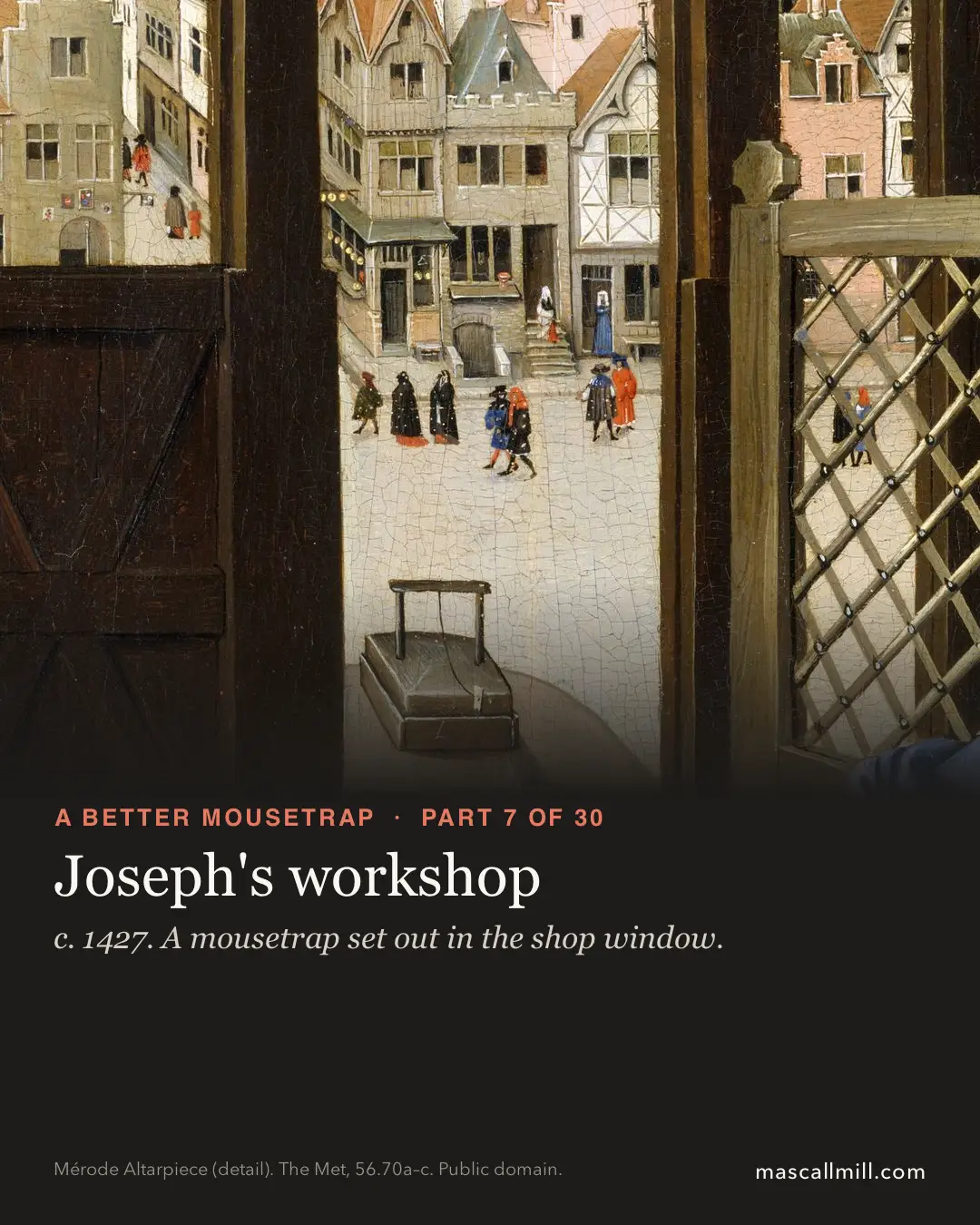
Part 6 ended on a guess: about a thousand years after Augustine, his mousetrap may turn up on a carpenter’s bench. Here is the bench.
Three panels
Around 1427, in the workshop of Robert Campin, someone painted a small altarpiece in three hinged panels. It is now called the Mérode Altarpiece.
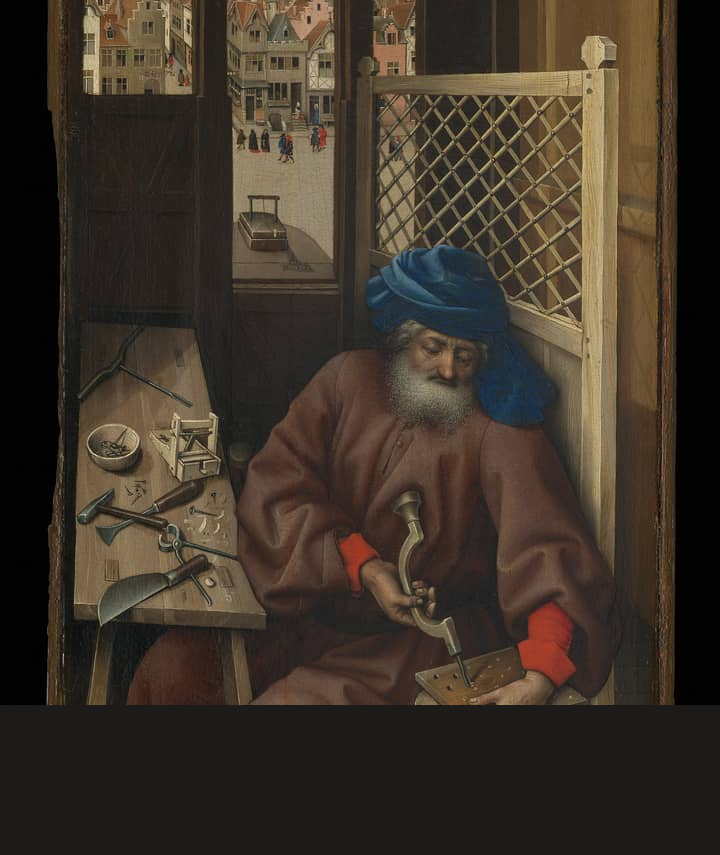
In the left panel, the couple who paid for it kneel outside a door. In the middle panel, the angel arrives to tell Mary she will have a child. In the right panel, Joseph is at work in his carpenter’s shop.
Two traps
Joseph sits at his bench, boring holes in a small board, with his tools laid out beside him. On the bench, among the tools, is a mousetrap.
There’s another one in the shop’s open window, set out on the sill, facing the street.
The devil’s mousetrap
In 1945 the art historian Meyer Schapiro argued that the two traps point to Augustine’s words from part 6: the cross is the devil’s mousetrap. He named his essay with Augustine’s Latin, Muscipula diaboli.
On that reading, the picture is a trap story. In the middle panel the bait is set: God becomes a man, and a man can die. In the right panel, the man who will raise the child has a trap on his bench and another in his window.
The painting tells us something plainer, too. By the 1420s a mousetrap was a thing a painter could put in a picture and expect everyone to know on sight. And both of these, once they caught a mouse, had to be emptied and set again by hand.
The painting hangs at The Met Cloisters in New York.
Next, part 8: No rats, 1284.
A new part every day. Follow along on YouTube, Instagram, TikTok, Threads or Facebook, or come back to the series.
Sources
- The Metropolitan Museum of Art, Annunciation Triptych (Merode Altarpiece), workshop of Robert Campin, ca. 1427–32, The Cloisters Collection, 1956 (56.70a–c): metmuseum.org/art/collection/search/470304 . Photographs: The Met, Open Access, public domain.
- Meyer Schapiro, "Muscipula Diaboli: The Symbolism of the Mérode Altarpiece," The Art Bulletin 27, no. 3 (1945).