 Mascall Mill
No rats, 1284
Act I: The problem ·
Listen · 2 min
That's the latest part. Part 20 comes next, with a new part every day: follow along on YouTube, Instagram, TikTok, Threads or Facebook.
Part 7 ended in a carpenter’s shop with two mousetraps in it. Part 8 is a story everybody thinks is about rats.
130 children
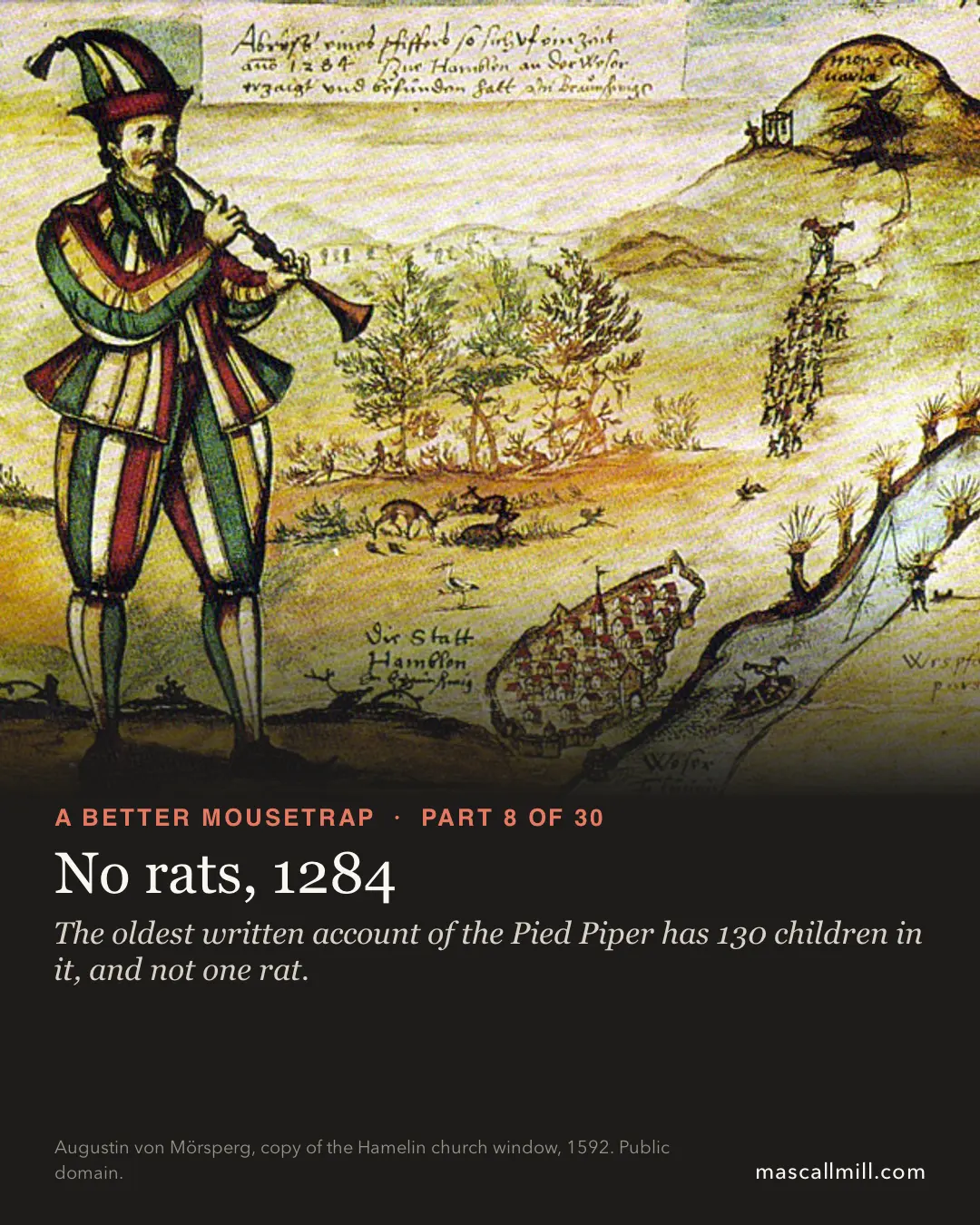
Around 1440–50, someone in Lüneburg, in northern Germany, wrote a note into a manuscript. It begins “Here follows a marvellous wonder, which transpired in the town of Hamelin”. In 1284, on the feast of Saints John and Paul, the 26th of June, a young man came playing a silver pipe. 130 children born in Hamelin followed him out of the town and were lost.
It is the oldest written account of the Pied Piper that survives. There isn’t a rat in it.
The window
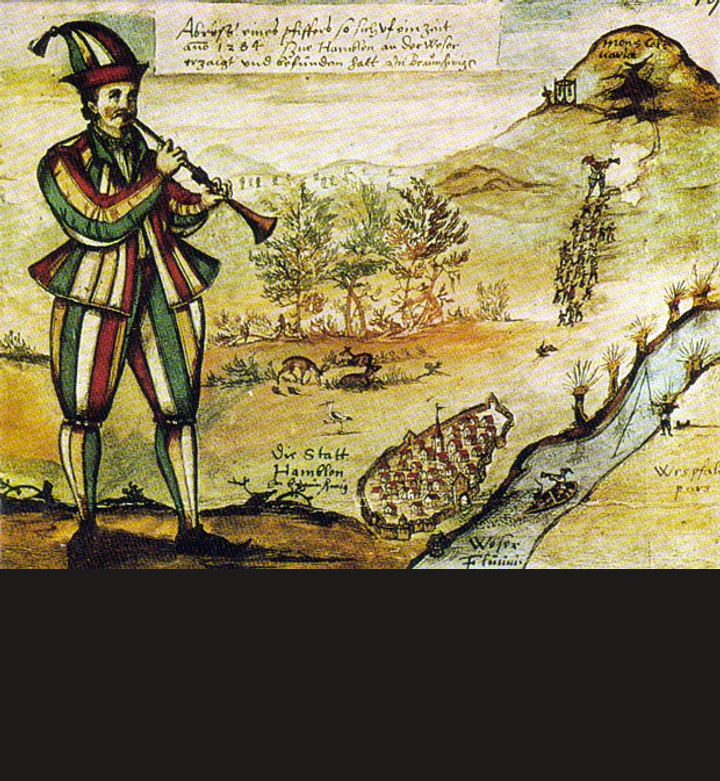
An older telling is lost. Around 1300, Hamelin’s market church put the story in a stained-glass window. The window was lost in 1660.
In 1592 a travelling nobleman, Augustin von Mörsperg, came to Hamelin to see its wonders for himself, and had the window copied. His watercolour is the oldest picture of the Pied Piper we have. The piper is in it three times.
Then the rats
The rats arrive in the 1560s. Count Froben Christoph von Zimmern, writing his family’s chronicle between 1559 and 1565, tells of a town “plagued with such a great number of rats” that it hired a stranger to clear them, and agreed to pay him several hundred gulden. It is the earliest account we know of that mentions them.
By 1592, Mörsperg’s own account has the piper lead “all the rats and mice out of the city”, go unpaid, and come back for the children.

A trap you only set once
No one has settled what happened to the children of Hamelin. What changed over those three hundred years was the reason the story gave.
Every trap so far in this series has to be emptied and set again. The piper was the dream of never having to: play once, and every rat in town is gone. In the story, the town doesn’t even want to pay for that.
In the same years, England’s Parliament was writing a law about rats and mice, and they put a price on them.
Next, part 9: The wanted list, 1566.
A new part every day. Follow along on YouTube, Instagram, TikTok, Threads or Facebook, or come back to the series.
Sources
- Museum Hameln, "Area 'Pied Piper'": museumhameln.de/?p=1080 . Augustin von Mörsperg's 1592 visit, his copy of the Marktkirche window (the oldest picture of the Pied Piper) and his account of the rats and mice.
- Augustin von Mörsperg, copy of the Hamelin Marktkirche window, 1592, Schlossmuseum Sondershausen. Image: Wikimedia Commons, File:Pied piper.jpg, public domain.
- The Lüneburg manuscript, c. 1440–50, and the Zimmern Chronicle, 1559–65, as summarised in "Pied Piper of Hamelin," Wikipedia: en.wikipedia.org/wiki/Pied_Piper_of_Hamelin .
- D. L. Ashliman, "Ratcatchers Who Abduct Children" (Zimmerische Chronik, in translation): sites.pitt.edu/~dash/hameln.html .