 Mascall Mill
The wanted list, 1566
Act I: The problem ·
Listen · 2 min
That's the latest part. Part 20 comes next, with a new part every day: follow along on YouTube, Instagram, TikTok, Threads or Facebook.
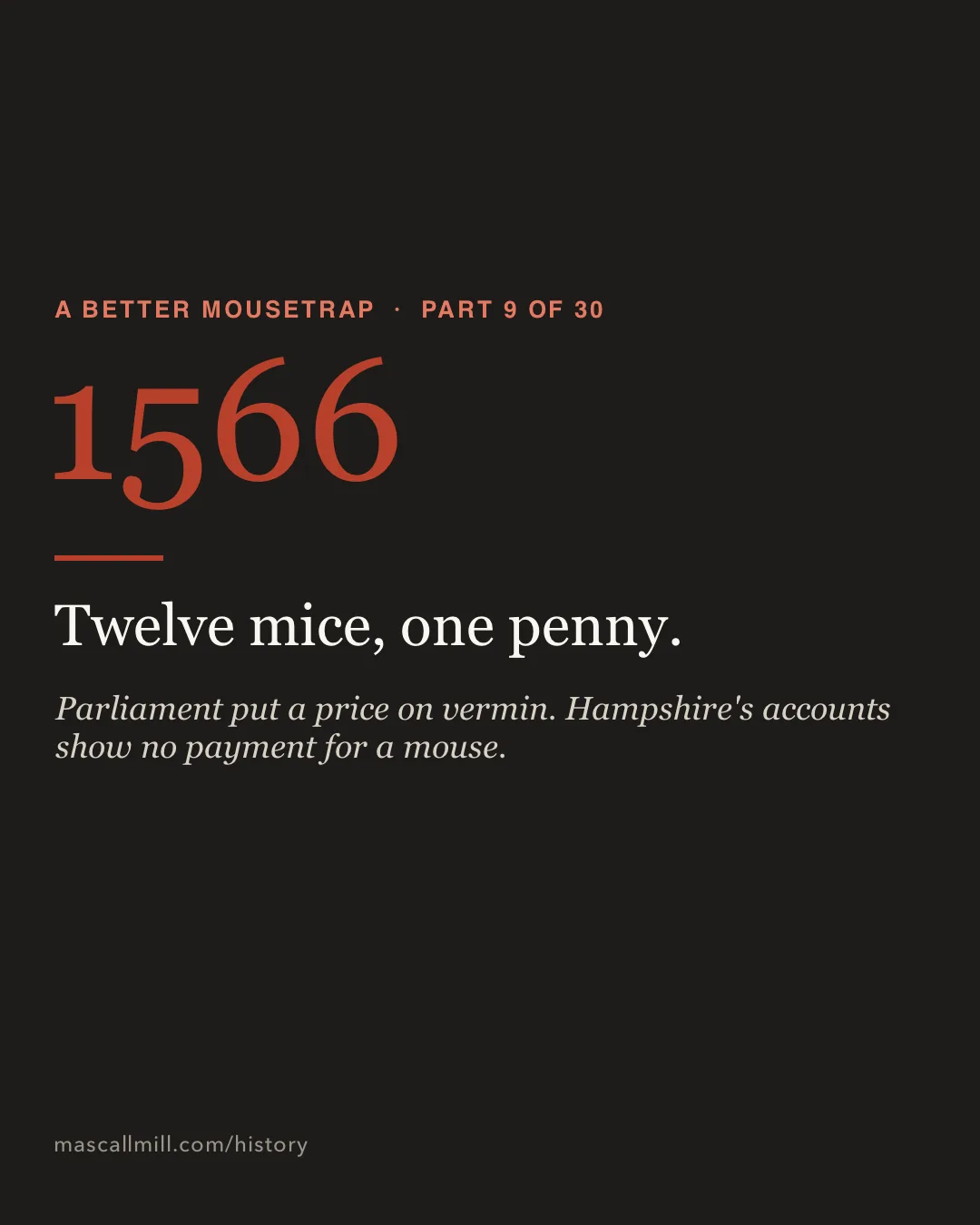
Part 8 ended with England’s Parliament putting a price on rats and mice. Here is the price.
The list
In 1566, with food prices rising, Elizabeth I’s Parliament passed “An Act for the Preservation of Grain”. It named nineteen birds and thirteen animals as “noyfull fowles and vermyn”, and told each parish’s churchwardens to pay for every one killed, out of a rate raised for the purpose. The heads were brought to the churchwardens, to be “burned, consumed, or cut in sunder” in front of them.
The Act set the prices. In its own spelling:
For the Heades of everie Foxe or Gray [badger] twelve pence. For the Heades of everie Otter or Hedgehogges two pence. For the Heades of everie three Rattes or Twelve Myse one peny.
A mouse was worth a twelfth of a penny. A fox was worth a hundred and forty-four of them.
Bring your own engine
The Act left the catching open. Anyone who wanted the money, with the landowner’s leave, could use “suche Nettes, Engynnes and other reasonable Devyses as are meet and convenient”: anything but handguns and crossbows.
It was renewed twice in Elizabeth’s reign, and it stayed law until 1863.
No payment for a mouse
In 2005 Douglas Anderson went through the churchwardens’ accounts of 176 Hampshire parishes, looking for every payment made under the Act. He found payments for sparrows, foxes, polecats, hedgehogs, otters and moles.
He also found what was missing. Mice and rats, “the most harmful of all vermin”, as he puts it, almost never appear. In all of Hampshire, one parish paid for them: Romsey, where in 1783 “Knowles for killing Ratts” was paid two shillings and sixpence, and eight years later “old Knowles the ratcatcher” got three and six. Neither payment mentions a mouse.
The law could say what a mouse was worth. For catching one, it allowed “Nettes, Engynnes and other reasonable Devyses”.
Twenty-four years later, someone wrote the engines down.
Next, part 10: The clerk of the kitchen.
A new part every day. Follow along on YouTube, Instagram, TikTok, Threads or Facebook, or come back to the series.
Sources
- Douglas Anderson, "Noyfull Fowles and Vermyn: Parish Payments for Killing Wildlife in Hampshire 1533–1863", Proceedings of the Hampshire Field Club & Archaeological Society 60 (2005), 209–228: hantsfieldclub.org.uk/publications/hampshirestudies/digital/2000s/vol60/Anderson.pdf . The Act's rates as quoted (p. 210), the nets and engines clause (p. 210), the 176 parishes studied (p. 212), parish counts by animal for 1775–99 (Tables 3 and 4, pp. 221–222), Romsey's rat payments and the absence of any mouse payment (p. 220; Tables 3 and 4 have no rats or mice column), and Mascall's 1590 book (p. 210, Fig. 1).
- "An Act for Preservation of Grain", House of Lords Journal, vol. 1, December 1566: british-history.ac.uk/lords-jrnl/vol1/pp662-663 .
- West Sussex Record Office, "The Wonderful World of Churchwardens Accounts" (2024): westsussexrecordofficeblog.com/2024/04/18/the-wonderful-world-of-churchwardens-accounts/ . The Act's list of animals, and its repeal in 1863.