 Mascall Mill
A clay box with a door, nearly 4,000 years ago
Act I: The problem ·
Listen · 3 min
That's the latest part. Part 20 comes next, with a new part every day: follow along on YouTube, Instagram, TikTok, Threads or Facebook.
Part 3 ended with a cat: mouse control that worked on its own schedule, not yours. People wanted something they could set and leave. An early candidate turned up in an Egyptian rubbish heap.
A town full of rats
In 1889 and 1890 the archaeologist Flinders Petrie dug out a town in Egypt that he called Kahun, now usually called Lahun. Its streets and mud-brick houses were laid out in the 12th dynasty, nearly 4,000 years ago.
The rats had been there too. “Rats were as great a plague in the XIIth dynasty as they are at present in Egypt,” Petrie wrote in his 1891 report. “Nearly every room has its corners tunnelled by the rats; and the holes are stuffed up with stones and rubbish to keep them back.”
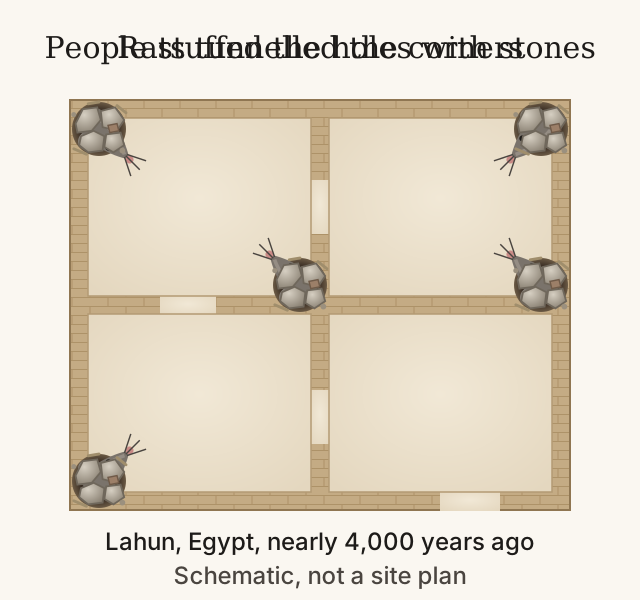
So the people of Lahun did what people still do. They blocked the holes.
The box
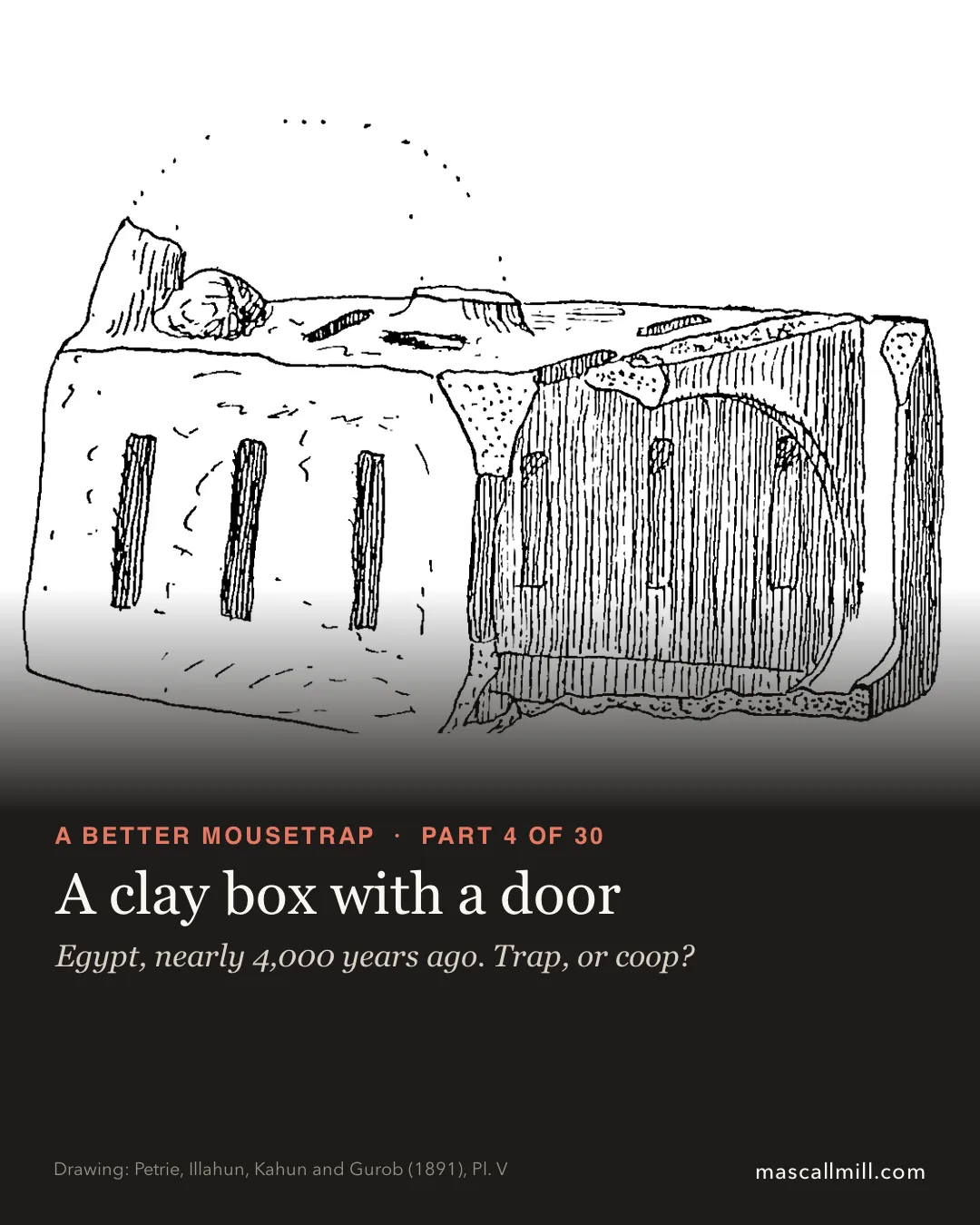
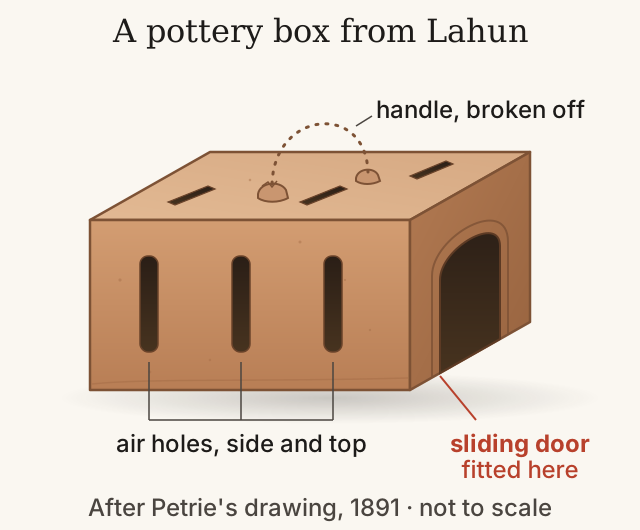
In a rubbish heap north of the town, Petrie’s team found something else: a pottery box, “pierced with air holes, and fitted with a sliding door.” It had been partly broken while it was still in use. A handle was missing from the top, and one hole had been stopped up with plaster in a repair. Petrie had it drawn for plate V of his report.
Trap or coop?
A box, a door, something inside. It’s tempting to call it a mousetrap. Petrie didn’t. “It was not intended merely for a trap,” he wrote, “as the number of air holes show: it must have been for retaining animals alive.” He called it a coop. His guess was that it held eggs in a hatching oven, so the chicks couldn’t stray when they hatched and could be carried off without getting cold.
Not everyone has followed him. The Petrie Museum in London, which holds much of what he found at Lahun, counts “what may be a rat-trap” among the town’s finds, as evidence of a rodent problem. Nobody at Lahun wrote down what the box was for, so the question stays open.
Either way, the idea in it is the one that lasted: get the animal into a box, alive, and shut the door behind it. The weak point is the door. Every time it shuts, somebody has to open it again.
Next, part 5: the Greeks fear it, the Romans name it.
A new part every day. Follow along on YouTube, Instagram, TikTok, Threads or Facebook, or come back to the series.
Sources
- Petrie, W. M. F. (1891). Illahun, Kahun and Gurob, 1889–90. London: David Nutt. Ch. II (rats) and Ch. III and Pl. V fig. 8 (the coop). Public domain. archive.org/details/cu31924086199514
- UCL Petrie Museum of Egyptian Archaeology. One Day in Lahun. ucl.ac.uk/museums-collections/petrie-museum/highlights/one-day-lahun