 Mascall Mill
The first trap had whiskers, 9,500 years ago
Act I: The problem ·
Listen · 2 min
That's the latest part. Part 20 comes next, with a new part every day: follow along on YouTube, Instagram, TikTok, Threads or Facebook.
Part 2 left the house mouse living with people who had stopped moving. Some thousands of years later, villages kept stores of grain, and the mice had more to eat than ever. Something had to be done about them. The first answer people found wasn’t a machine.
Shillourokambos
Shillourokambos is a Neolithic village on Cyprus, excavated by a team under the French archaeologist Jean Guilaine. In 2004, Jean-Denis Vigne and his colleagues reported a burial there in the journal Science. It is about 9,500 years old.
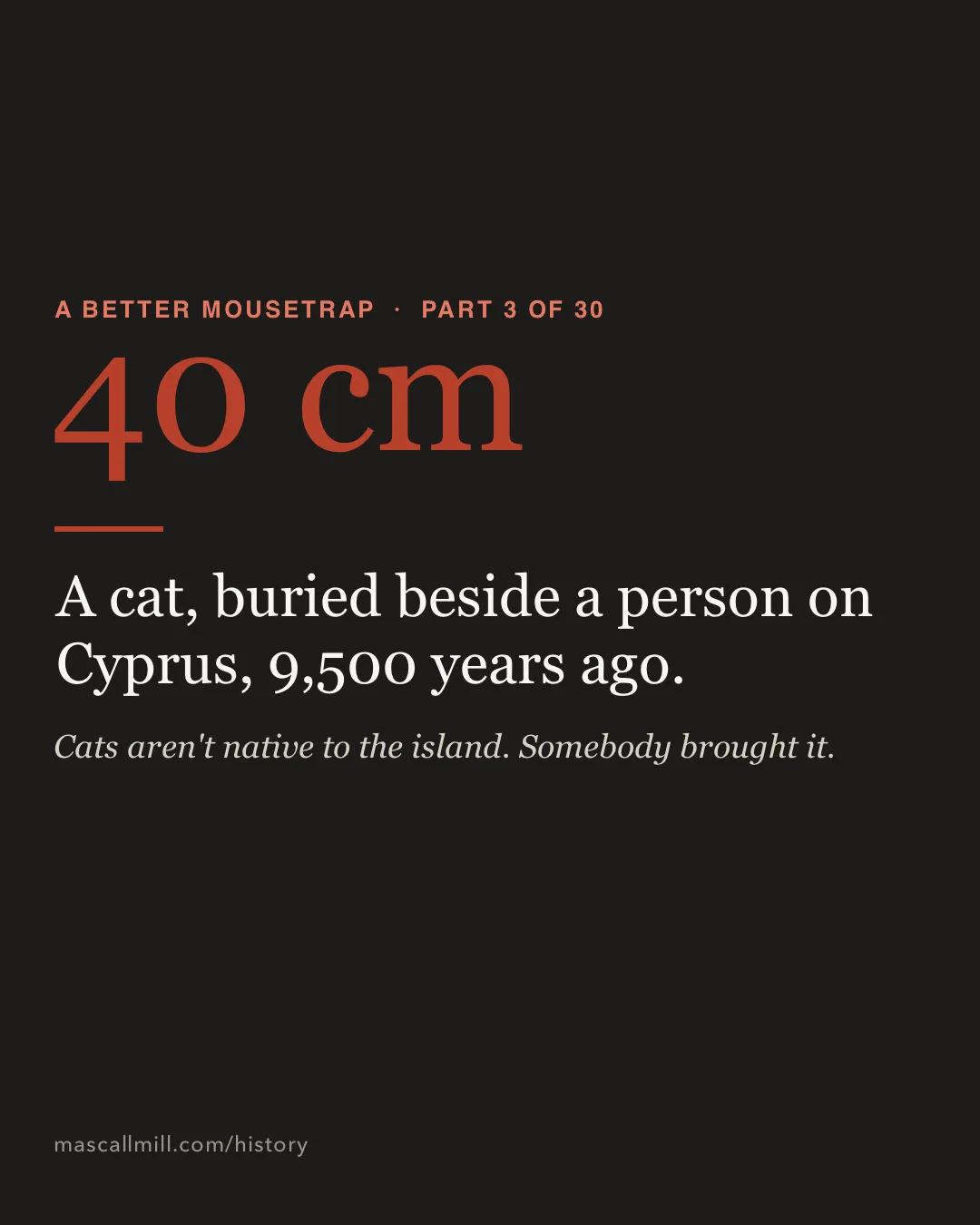
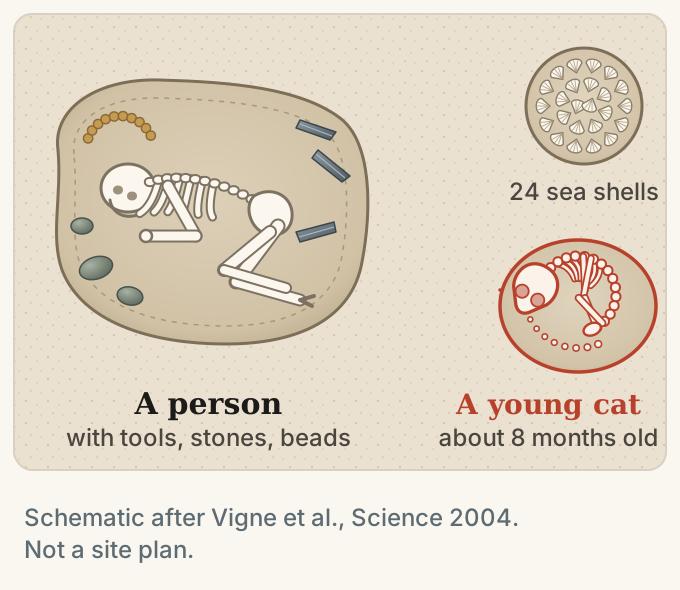
A person had been buried with polished stones, tools, jewellery and other offerings. A small pit nearby held 24 complete sea shells. And 40 centimetres from the grave lay the skeleton of a cat. National Geographic’s report says the analysis put it at about eight months old.
Somebody brought it
Cats aren’t native to Cyprus. There were no wild cats on the island to tame. People had carried them over the sea from the mainland.
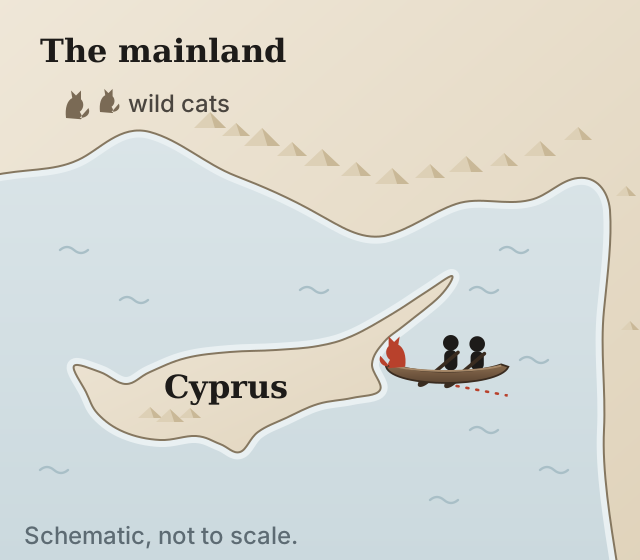
The team couldn’t say whether the cat was wild or tame. What they could say, Vigne told National Geographic, was this: “With this discovery, we can now decide that cats were linked with humans.” Whether the people of Shillourokambos had domesticated cats is still an open question.
Why a cat
Vigne’s explanation is about mice. “It seems that cats probably came more and more frequently into villages where grain stocks attracted numerous mice,” he said. The wild cats came for the mice. People, it seems, came to see the point of keeping them around.
So the oldest mouse control we know of is probably about 9,500 years old, and it had whiskers. It never needed resetting. It just needed feeding, and it worked on its own schedule, not yours.
People wanted something they could set and leave. The next idea was a box.
Next, part 4: a clay box with a door.
A new part every day. Follow along on YouTube, Instagram, TikTok, Threads or Facebook, or come back to the series.
Sources
- Vigne, J.-D., Guilaine, J., Debue, K., Haye, L. and Gérard, P. (2004). Early taming of the cat in Cyprus. Science 304(5668): 259. pubmed.ncbi.nlm.nih.gov/15073370/
- American Association for the Advancement of Science (2004). Oldest known evidence of cat taming found in Cyprus. ScienceDaily, 9 April 2004. sciencedaily.com/releases/2004/04/040409092827.htm
- Pickrell, J. (2004). Oldest known pet cat? 9,500-year-old burial found on Cyprus. National Geographic. nationalgeographic.com/animals/article/oldest-known-pet-cat-9500-year-old-burial-found-on-cyprus