 Mascall Mill
How the mouse moved in, 15,000 years ago
Act I: The problem ·
Listen · 3 min
That's the latest part. Part 20 comes next, with a new part every day: follow along on YouTube, Instagram, TikTok, Threads or Facebook.
Ask most people when mice became a problem and they’ll say farming: grain in storage, and mice to eat it. That’s a reasonable guess, and it’s wrong by a few thousand years.
Ain Mallaha
About 15,000 years ago, in the upper Jordan Valley in what is now northern Israel, a group of hunter-gatherers archaeologists call the Natufians did something new. They stopped moving. At sites like Ain Mallaha (also called Eynan) they built round stone houses and lived in them for long stretches, year after year.
They still hunted and gathered. Nobody there was farming yet. But they were staying put, and staying put changed the neighbourhood.
The evidence is in the teeth
In 2017 a team led by the archaeologist Lior Weissbrod published a study in the Proceedings of the National Academy of Sciences that tracked the mice of the Levant across a 200,000-year fossil record. Mouse species are hard to tell apart from bones, so the team measured the precise shape of their molars, a method called geometric morphometrics.
Two species turned up. One was the house mouse, Mus musculus domesticus. The other was a wild relative, the short-tailed mouse Mus macedonicus. When the Natufians settled down at Ain Mallaha, house mice took over and pushed the wild mice out. In later layers, when people there moved around more again, the wild mice came back.
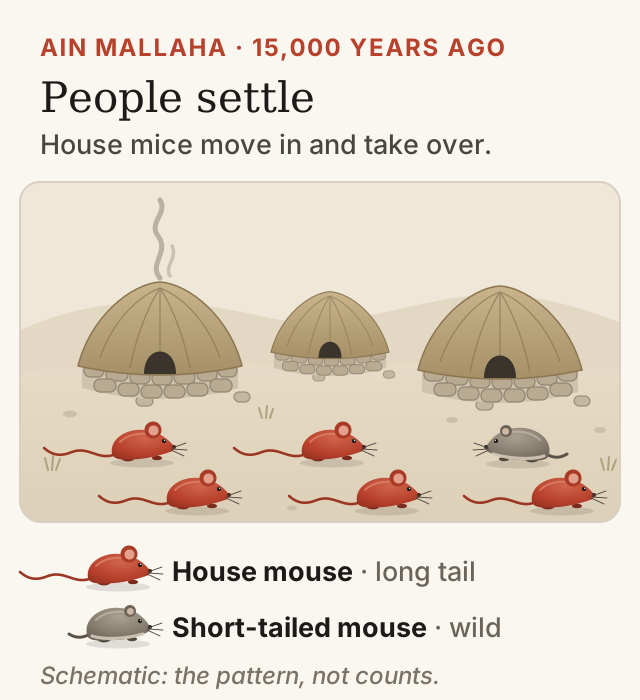
The pattern, not the counts. After Weissbrod et al., PNAS 2017.
The team compared the pattern with rodents living today around the settlements of herding peoples in Africa, and found the same kind of shift there: the longer people stay in one place, the more the species that lives off them takes over.
Older than the grain bin
That makes the house mouse one of our oldest neighbours. It moved in with us before we farmed, before we had cats, and long before we had anything you’d call a trap. What drew it in wasn’t a granary. It was people who stayed in one place, with food, shelter and rubbish that didn’t move on.
It’s the same deal mice take today. A house mouse is a commensal: it lives off us, in our buildings, and it rarely goes far from home. The University of California’s pest notes say house mice “seldom venture more than 30 feet from their nest sites”, and that they move into homes in autumn when the nights get cold.
So the problem this series is about is roughly 15,000 years old. The first thing people found to deal with it wasn’t a machine. It had whiskers.
Next, part 3: the first trap had whiskers.
A new part every day. Follow along on YouTube, Instagram, TikTok, Threads or Facebook, or come back to the series.
Sources
- Weissbrod, L., Marshall, F. B., Valla, F. R., Khalaily, H., Bar-Oz, G., Auffray, J.-C., Vigne, J.-D. and Cucchi, T. (2017). Origins of house mice in ecological niches created by settled hunter-gatherers in the Levant 15,000 y ago. PNAS 114(16): 4099–4104. pubmed.ncbi.nlm.nih.gov/28348225/
- Quinn, N. and Frye, M. (2025). House Mouse. UC IPM Pest Notes 7483. ipm.ucanr.edu/PMG/PESTNOTES/pn7483.html