 Mascall Mill
A Better Mousetrap: the history of the mousetrap in 30 parts
Act I: The problem ·
Listen · 4 min
That's the latest part. Part 20 comes next, with a new part every day: follow along on YouTube, Instagram, TikTok, Threads or Facebook.
Right about now, as the nights turn cold, mice move indoors. The University of California’s pest notes put it plainly: house mice “frequently enter homes in autumn when nighttime temperatures become colder.” They come into garages, sheds, barns, basements and cabins. They can squeeze under a gap a quarter of an inch tall and jump a foot straight up onto a shelf. Most of them never go more than about 30 feet from where they nest.
None of this is new. House mice have lived alongside people for about 15,000 years, since before anyone planted a field. And for most of that time, people have been trying to get them out.
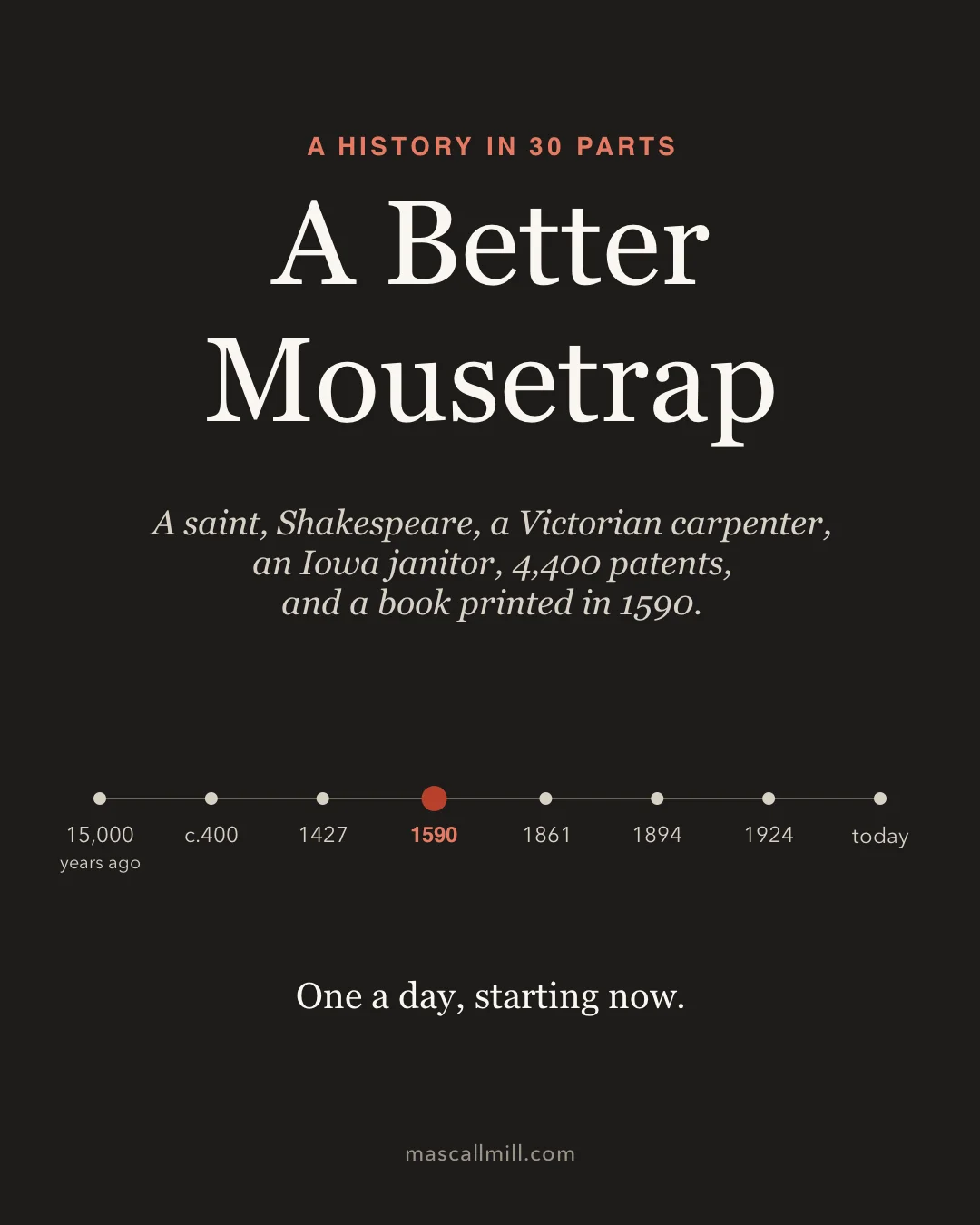
This is the story of how we’ve tried. It runs for 30 parts, one a day.
Four acts
Act I: the problem. Mice move in with the first villages. Then come the cat, the clay box with a sliding door, a Greek poem with a mousetrap in it, a Roman joke, a saint who called the Cross “the devil’s mousetrap”, a painting of Joseph at his workbench with a mousetrap in the shop window, the Pied Piper, and an English law of 1566 that put mice on a parish wanted list.
Act II: the mill. In 1590 a London printer brought out a small book of “sundrie engines and trappes” put together by Leonard Mascall, clerk of the kitchen to the Archbishop of Canterbury, who had died the year before. One of its mouse traps is a little mill: a wheel of vanes on a free spindle, baited, set over a pan of water. A mouse steps out for the bait, the vane turns under it, and the next vane comes round. Nothing to reset.
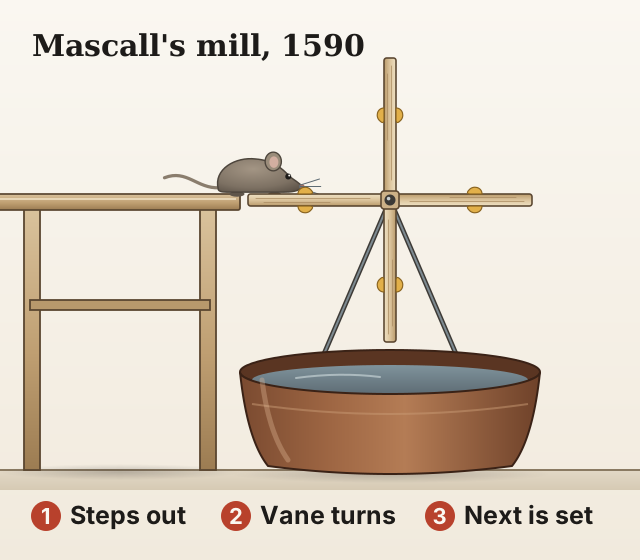
Mascall’s mill as his 1590 book describes it: two thin boards set crosswise on a wire, baited near the ends, over a pan of water. Our drawing.
Act III: four hundred years of resetting. Hamlet’s play-within-a-play, Dutch paintings, a trap found under a floor, a German village that lived on wire traps, a Sussex carpenter’s see-saw, a wind-up trap from Pennsylvania, Emerson’s most famous line (which he never wrote), the snap trap of 1894, more than 4,400 American patents, and an Iowa school janitor with an oil can and a tobacco tin.
Act IV: back to the mill. What mice actually do, the rodent scientist who built a wooden copy of Mascall’s mill, why the mill didn’t last, and how we rebuilt it.
The thread
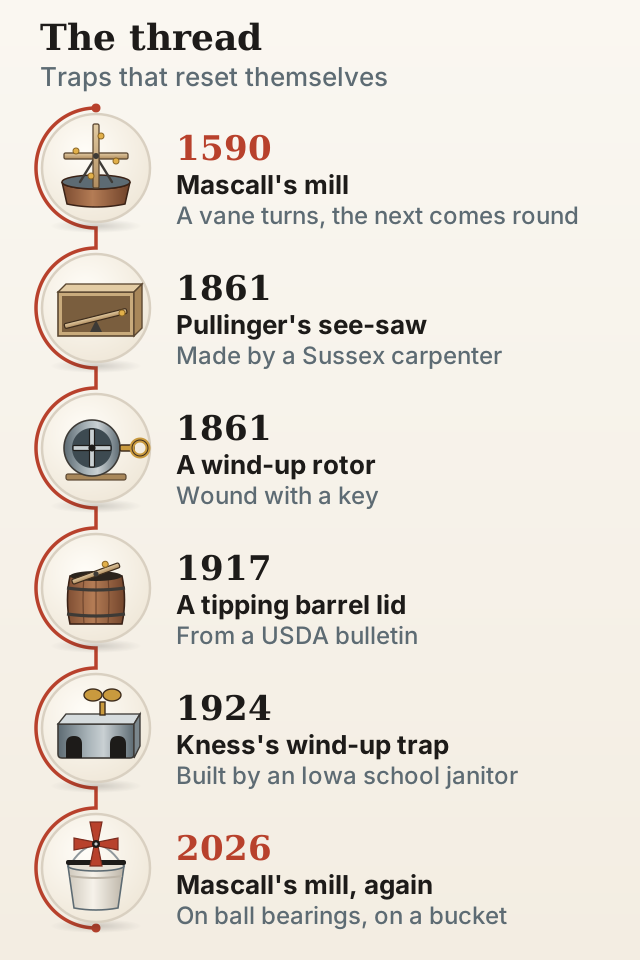
Almost every trap in this story has the same weakness: it catches one mouse, and then somebody has to come and reset it. People kept solving that problem, and the solution kept getting lost. Watch for it. It turns up in 1590, in 1861 (twice), in 1917 and in 1924.
How we checked
Mousetrap history is full of good stories that aren’t true. Every claim in this series comes from a museum record, a patent, a primary text or a peer-reviewed paper, and the sources are listed at the bottom of each part. Where the evidence is thin, we say so. Where a famous fact falls apart, we leave it out, or we tell you it falls apart, which is sometimes the better story.
Who’s telling it
We’re Mascall Mill, in Bellingham, Washington. We make a version of Mascall’s 1590 mill that clamps to a 5-gallon bucket. We got interested in the history because we were building the trap, and it turned out to be a better story than we expected.
Next, part 2: how the mouse moved in.
A new part every day. Follow along on YouTube, Instagram, TikTok, Threads or Facebook, or come back to the series.
Sources
- Quinn, N. and Frye, M. (2025). House Mouse. UC IPM Pest Notes 7483. ipm.ucanr.edu/PMG/PESTNOTES/pn7483.html
- Weissbrod, L. et al. (2017). Origins of house mice in ecological niches created by settled hunter-gatherers in the Levant 15,000 y ago. PNAS 114(16): 4099–4104. pubmed.ncbi.nlm.nih.gov/28348225/
- Hope, J. (1996). A Better Mousetrap. American Heritage 47(6). americanheritage.com/better-mousetrap
- Mascall, L. (1590). A booke of fishing with hooke & line… Another of sundrie engines and trappes to take polcats, buzards, rattes, mice and all other kindes of vermine & beasts whatsoever. London: John Wolfe for Edward White.